Olesia Khromeichuk is a historian and writer who has walked the darker side of life. In this essay, she speaks candidly about resisting cancer, about chemotherapy as transformation — an experience that reshapes not only the body, but one’s understanding of life, death and womanhood. Her story echoes that of a modern Persephone, who tasted the pomegranate seeds and returned from the darkness changed. The essay is part of Wounds and Words, a series in which the author reflects on history, politics, culture and her own journey through cancer.
I agreed to be poisoned because I wanted to live.
“You’re young; we’ll pour everything we can into you so you can go on for another forty years,” said my optimistic doctor. I have a difficult relationship with optimism, but I chose to entrust myself to her. Thus began my latest phase of shapeshifting.
Having my first infusion was a bit like having sex for the first time: everyone tells you it will be unpleasant, but it’s worth it in the long run. What people don’t tell you is that, like sex, chemotherapy leaves you a changed woman.
“You look so good! You’ve not changed a bit!” said an acquaintance who under the best of circumstances tends to lack a basic sense of tact. “If I didn’t know you were sick, I wouldn’t be able to tell!”
Sick people are meant to look sick. If we dare to embody the unwelcome reminder of mortality, we had better pull off the look to match it. Having gone through months of debilitating fatigue, nausea, neuropathy, insomnia, mouth ulcers, hot flushes, food intolerance, migraines, joint aches and other gifts that the treatment brings, I didn’t pass as a cancer patient because I had a ton of makeup on and “looked so good!” I felt an overwhelming urge to whip off my wig and ask her: “What about now? Can you tell I have cancer when I look like this?”
“The wig is in the way,” a writer I deeply admire told me in our private correspondence. She didn’t (necessarily) mean my actual wig; she was warning me against writing in a way that doesn’t inconvenience others, that makes it easier for readers to be in the presence of my words.
Sugar-coated text can be easily swallowed; its bitterness can go unnoticed. Bold words, like a bald head, can unsettle, shift, transform.
The poison that is meant to keep me alive is red and relentless. It lives up to its nickname: the Red Devil. Blended with my blood, it’s circulating in my veins, attacking all rapidly dividing cells, without discriminating between good and bad. It has changed me inside and out.
It has leached the colour from my skin, and, in return, I make it lend it to my words. As it spills onto the page, I watch the shapes it forms.
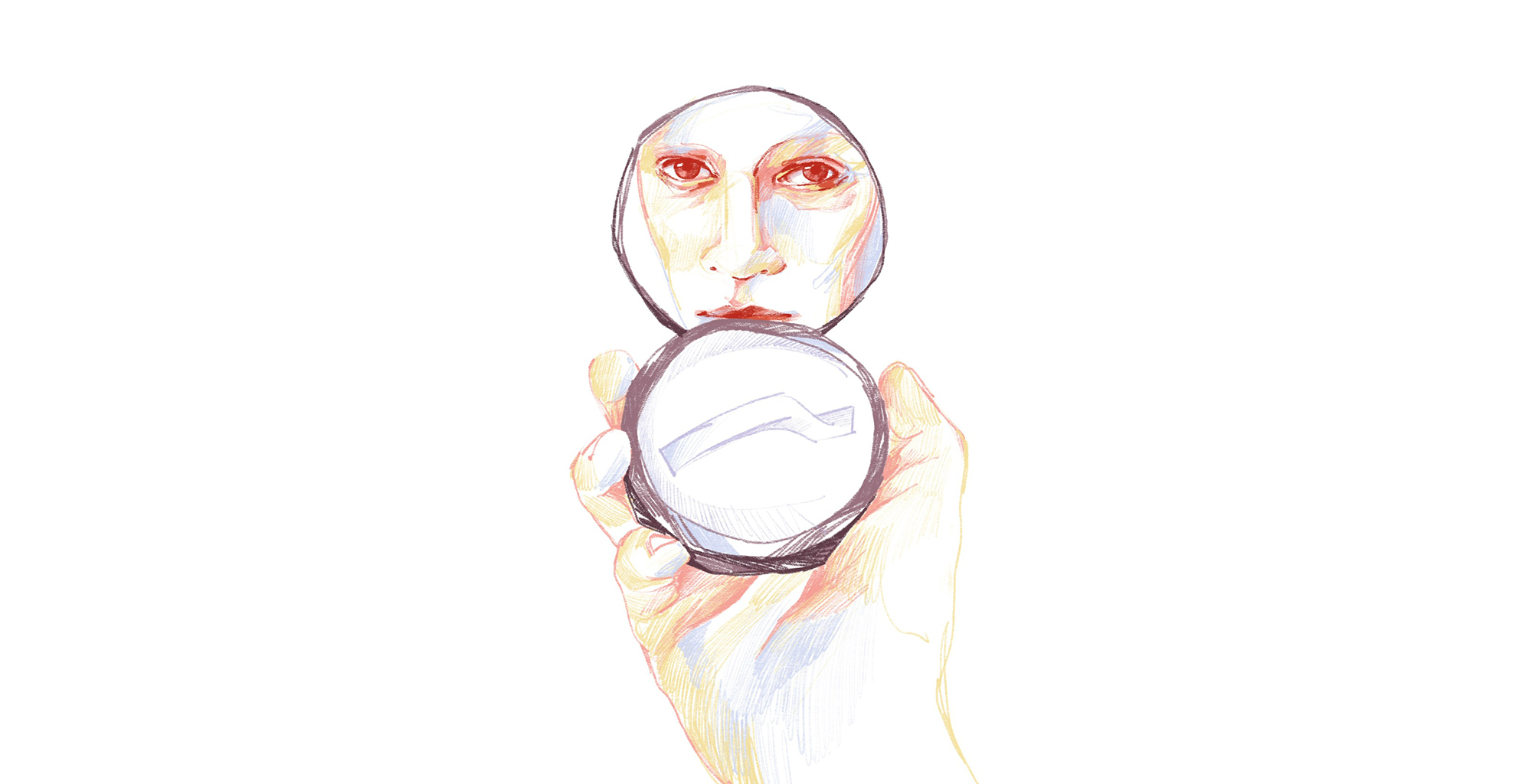
I glimpsed her through the narrow opening of the door, and she took my breath away. She sat before a dressing mirror: silent, still, serene. In contrast, a younger woman busied herself around the room, straightening the dress hanging nearby — its fabric shimmering in the evening light — and fussing over a row of blonde and brunette locks. She then plugged in what looked like a soldering iron, and for a moment, I wondered what she intended to do with it. But my attention was quickly drawn back to the woman whose gaze was fixed on her reflection. Her face was softly illuminated by the lightbulbs that framed the mirror. Her hair was pulled back into a sleek ponytail, her skin pale, her eyes deep and heavy with sadness. She reached out for a palette of soft nudes and beiges, and began applying them to her face. Stroke by stroke, she transformed herself from a woman worn down by life into someone ready to love, hate, and everything in between. That was the moment I knew I wanted to become an actor.
***
My dressing room was two doors down. A ten-year-old, I was sharing it with other kids. We were rehearsing for a show that was to be held in the Lviv Opera House in my hometown, in western Ukraine, a few days later. The actor I spied on through the gap in the door was getting ready for a performance that was on that night. The next time I peeked in, I saw some of the locks getting attached to her ponytail by the younger woman. To give the tired strands of hair a new bounce, she was skilfully using what I had thought to be a soldering iron but what was actually an old-fashioned curler. By this point, the actor was fully made up. Only the glistening dress was needed to complete the transformation.
A few years later, when I started to get parts not only in children’s shows but also in professional productions, I got to see the ‘soldering iron’ up close, although I didn’t get any locks attached to my hair. I also got to use a similar actors’ make-up palette. The shades transformed my young complexion into features that didn’t immediately fade under the merciless brightness of theatre lights. Sitting in front of the dressing mirror framed by a line of light bulbs, I had been allowed in on a secret of the world of shapeshifting.
Women are particularly skilled at shapeshifting. Some might say it comes naturally to us. However, as one of my favourite feminist theorists warns, if something is presented as natural — question it.
We are skilled because we are expected to transform ourselves, and in particular, our appearance, to suit the needs and wants of others.
From a young age, girls are taught how to look, dress, and shape their bodies. I was no exception. At ten, I was mesmerised by the transformation of an actor at the Opera House. By my teenage years, I had fully embraced the rituals myself: I attended make-up classes and could change from an exhausted schoolgirl juggling theatre rehearsals, music lessons, and studies into a princess within minutes. A little queen of fakes, I was ready to step into womanhood.
As I gained confidence and maturity, I began to realise that this charade was stifling. Instead of rebelling, I compromised, as any well-brought-up young woman would. In private, I was a teenager with multi-coloured hair, bandanas, torn jeans and platform shoes. In public, I was the elegant mademoiselle, a model of femininity for other young women in my town to follow. And follow they did! As I gained some local fame through my theatre and TV work, more and more girls told me they wanted to be just as graceful and feminine as I appeared. Little did they know that as time went on, I began to loathe the elegance they admired and longed for rebellion.
If you wish for something hard enough, chances are it will eventually come true. My rebellion arrived with my first marriage. My otherwise perfectly good husband wanted to turn me into a goddess of femininity. I thought I was goddess enough as I was. Each time he bought me red lipstick, I painted my lips black. For every short skirt he gave me, I bought a pair of baggy trousers. Tight, revealing tops purchased by him ended up in charity shops, while my oversized Nirvana t-shirts became worn out with love. Eventually, he realised the only way to win this battle was to have it with someone else.
***
My vein is burning as if someone is pouring not a drug but pure fire into it. I can see it turn red and angry. The nurse looks lost as I insist she does something.
“Would you like me to move it to the other arm?” she asks.
“I have no idea! You’re the one who’s meant to know what to do. This is my first time,” I respond forgetting basic manners.
The vein is throbbing more and more. She takes the cannula out. The affected part turns black almost immediately. A kiss from the Red Devil. The dark shape will stay on my arm for months. It will keep hurting now and again lest I try to pretend that nothing’s changed.
***
I returned to shapeshifting in my late thirties. Ukraine, my country of birth, was under attack, caught in a brutal war, and I found myself among its spokespersons. I gave talks, interviews and lectures, urging the world to finally care about this corner of Europe now that it was being ripped apart. No one wanted to see my eyes, red from crying and sleepless nights, or my face, pale with exhaustion and anger. If a woman looks “traumatised,” she might get pity or compassion, but she won’t command authority.
Such are the rules developed by patriarchy over millennia, and I couldn’t afford to challenge them just then. So I reached for the familiar palette of nudes and beiges. The red lipstick became my shield, as did the elegant dresses I had scorned just a decade earlier.
“Don’t let them take that away from you,” an Afghan activist told me as we both prepared for our TV interviews, each speaking about our own corner of global violence. It was 8th March, International Women’s Day — the one day when women are encouraged to discuss politics. My big war was only a few weeks old, and the shock was written all over my face. She had years of experience of speaking to audiences about grief and devastation.
“Don’t let them take your dignity away,” she added, resting a steady hand on my trembling shoulder. “Bright lipstick, bold clothes, head high. Do whatever it takes, but don’t let them see your pain.”
I followed her advice. Whenever I spoke about death and destruction — mass graves, occupation, torture chambers — I made sure to look my best, careful not to alienate allies who, untouched by the grief of war, were too delicate to handle my raw pain. I smiled when I wanted to cry, refusing to let my enemies see the cracks inside. But if the haemorrhage isn’t stopped, the red blood darkens, and no nude or beige will hide the darkness beneath.
***
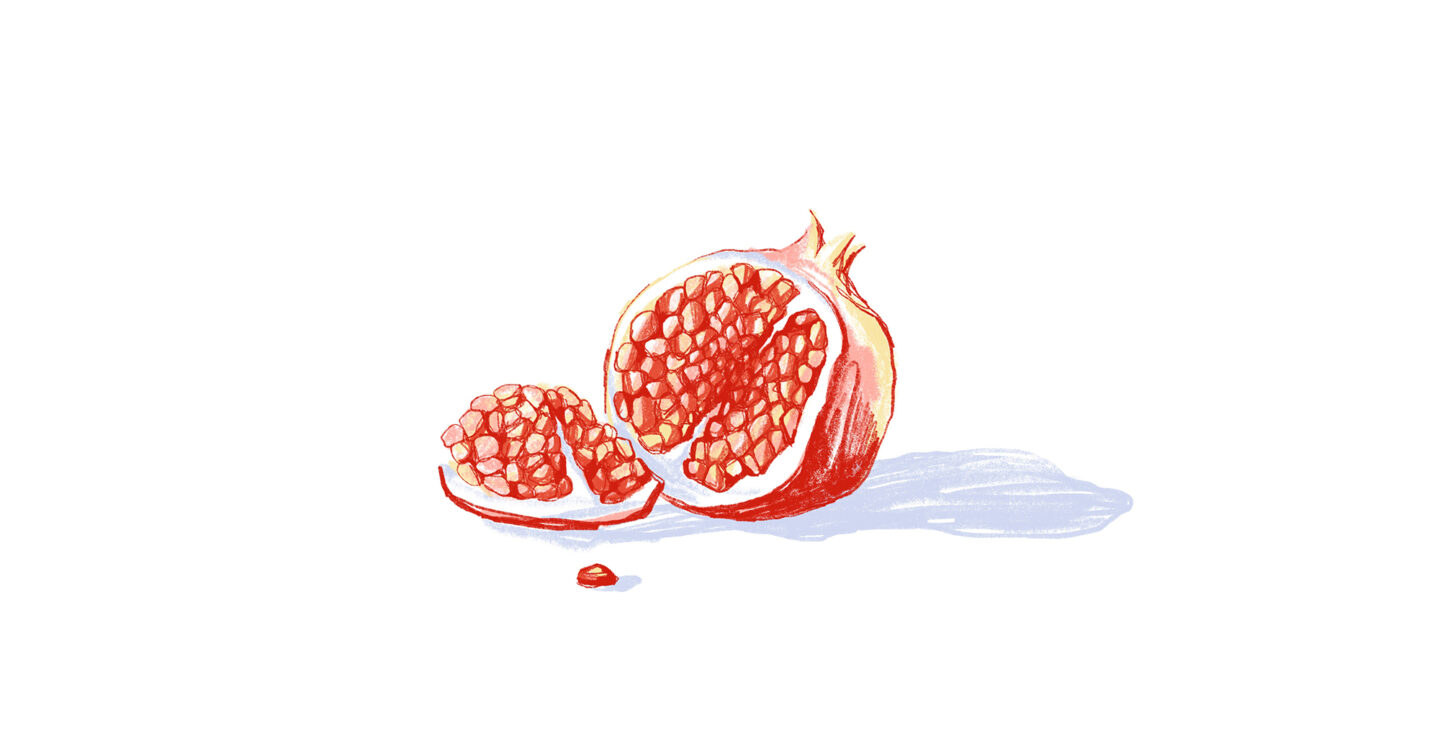
Why did Persephone taste the pomegranate seeds? Those teardrop-shaped gems of crimson that deceive with their sweet flavour, only to leave a sharp bite in its wake. Did she know that with each taste, she would be bound to the Underworld for eternity?
Half-delirious, I listen to a new audiobook on Greek mythology as red droplets trickle into my veins, searing behind my eyes, making their way down my throat, filling my chest, and spreading through every part of me. The underworld feels closer than ever.
I wonder whether Persephone was tricked into tasting those seeds. Hades was hardly one for consent. Or perhaps, having changed from a maiden into queen — albeit not of her own volition — she longed to stay in the Underworld.
The last of the red runs dry, and I’m released into the light. Yet a part of me lingers in darkness, and what returns is transformed by it.
***
When I was first diagnosed with breast cancer and told that chemotherapy would change my appearance — especially through the loss of my hair — it wasn’t the illness itself that worried me. Instead, I feared that I wouldn’t be able to do my job well. I’d look exhausted. No one would take me seriously. No one would listen. People shy away from reminders of their own fragility and mortality. Without the armour of my feminine charm — a weapon I’ve wielded when my male interlocutors’ reason failed — how would I make them hear me?
I began stocking up on anything that might help. A simple makeup kit was no longer enough. My flat was slowly turning into a beauty salon: boxes of special creams and lotions (chemo makes your skin sensitive, so even the best brands had to be shelved for better days), false eyelashes of every variety, shimmering blushers to mask pale cheeks, and various shades of rouge to soften the weight loss on my cheekbones. A crocheted hat, a headscarf, a line of bright lipsticks. And a wig.
For weeks, I wore this protection, complete with a smile. “I’mfine-I’mfine-I’mfine,” I said to myself and others. Those who knew me well played along. Those who didn’t, choose to believe it: if I’m fine, there’s no need to accommodate my new reality.
The one person I couldn’t fool was looking back at me from the mirror. Much like the actor from my childhood, her eyes were weary — not just from the treatment that sapped her energy, but from all the pretending. Eventually, I’d had enough of it.
Why fight just one battle when you can take on a few? Alongside my illness, I decided to confront the inner demons planted by years of being told how to be a woman. Fortunately, feminist resolve acquired over the same period doesn’t vanish easily, and when you forget how to fight for yourself, there are always other women nearby to remind you.
My first step was to shave my head. Until my hair started to fall out, I hadn’t realised how painful the process could be — physically sore and psychologically debilitating. After weeks of grieving its loss, I chose to stop watching it come out in fistfuls and simply let all of it go.
Three women, like goddesses of the underworld, welcomed me into their basement beauty salon to guide me through this ritual.
“Don’t worry, babes. Some men go crazy for bald women,” one said, trying to lift my spirits.
“That’s the last thing on my mind!” I replied with a laugh, though tears rolled uncontrollably down my cheeks.
I lied, of course.
“All done. Do you want to look?” asked another. “You don’t have to. We can put the wig on right away if you’d rather not see.”
“Of course, I’ll look,” I replied.
That was the whole point: to see, to confront myself as I was in that moment, not as I ought to be in order to make others more comfortable.
“Good on you! Here you go, love. What do you think?” One of the goddesses asked as she turned me to face the mirror.
The mirror, framed by bright lights, transported me back to my curious ten-year-old self. There we stood: she, taken aback by the unfamiliar reflection, and I, gazing at her, gently saying: “It’s okay. It’s still me. You. Us.”
“What do you think, love? You look pretty cool, actually. Not everyone can rock a bald head like that!” Another goddess brought me back to reality.
“I look like one of my brothers — the one who always has a buzz cut. I don’t look bad for a girl,” I replied with a giggle.
I looked at my locks scattered across the floor and felt an unexpected sense of liberation. My ten-year-old self remembered the “soldering iron” and those perfect curls in the dressing room. I reassured her that we could still enjoy the curls — but for a while, it would have to be on a wig.
***
The first time I encountered the notion of shapeshifting as a cultural practice was when my eldest brother sent me one of his drawings. Before he became a soldier, he made art, and I loved exploring the world he created in his imagination and allowed to spill over into his drawings and paintings. In this particular small picture, my brother managed to fit the past, the present and the future. It showed a bearded man in a long overcoat with a hat pulled over his eyes walking along a path that stretched far behind him. He grasped a walking stick in his right hand, while a wild cat walked by his side. Above him soared a bird of prey, perhaps an eagle. Their path continued, but we, the viewers, could not tell where it would lead. Knowing my brother’s interests in practices of transformation, I understood that the man was a shapeshifter, and the creatures represented the forms he assumed when his human guise was insufficient.
After my brother’s death, I had the task of selecting an engraving for his tombstone (municipal authorities permit the grieving families to personalise the reverse side of the tombs in military cemeteries). He was killed in action in Russia’s war and so his grave is that of a Ukrainian soldier: the granite shaped into a cross made his final resting place austere, uniform, institutional. I wanted to believe that his death was his ultimate transformation. I liked to imagine that, just like that of the man in his drawing, my brother’s journey continued — only now it had moved beyond the picture, where I couldn’t see it. So I chose to engrave his drawing on the back of the gravestone. Now, the wise man, the cat, and the eagle keep my brother company. When I visit his grave, I look out for stray cats in the neighbourhood and make sure to gaze at the sky in case there are any birds of prey.
***
When well-meaning friends buy me socks that say “fuck cancer” I never know quite what to do with them. Breast cancer cells form because of changes in normal breast cells. When they mutate, they become unruly, ignore signals to stop dividing, and avoid their natural death. United and unchecked, they form a tumour that can eventually be lethal to the very body of which it is made. In my non-medical mind, I picture these cells as normal ones that have gone off the rails. It is a type of behaviour I have some sympathy for; a form of self-sabotage I recognise. But they don’t make socks that say “hello-rogue-cells-I-want-to-get-to-know-you-better-so-I-can-understand-why-you-lost-your-shit.” Maybe they should. I would buy a pair.
The shape of my tumour was smooth enough to fool the first doctor who touched it into thinking that it was “nothing to worry about.” As it grew, its edges sharpened. In time, I could feel its blade pressing through my skin. After five months of chemotherapy, just as I prepared for surgery to remove the mutated cells, I could barely locate the tumour with my fingertips. The Red Devil seemed to have dulled the blade. The tumour shifted its shape as it reshaped me.
In preparation for recovery, I put together a list of things to aid my healing. I add some pomegranates to it.
***
When I was little, whenever I had a high fever, I’d dream of shapes. A giant triangle floating in darkness, forcing its wedge into a rectangle beside it. Both would shatter in the collision, forming smaller shapes from the shards. The circles were always the ones to give in, folding under the weight of bladed forms. I’d wake up struggling to breathe, my forehead covered in drops of sweat.
As a treat, my father would buy me pomegranates, a delicacy from the world of warmth and sunshine, packed with nutrients meant to restore my strength. My mother would peel the fruit and arrange the seeds on a pretty plate, making them easy to eat for a child weakened with a fever. I would pick up the little red teardrops one by one, crushing them in my mouth to feel a burst of sweetness followed by a hint of sharpness. A rogue seed would fall on the white sheets now and again and get crushed, leaving a shape that looked like a bloodstain.