TEXT: Khrystyna Shalak
Lyubov Panchenko:
A Fashion Designer from Bucha
“If I give them away now, what will I have left? They are like my children,” Lyubov Panchenko said about her works. Those who visited her recalled that the artist's home was decorated with her collages and embroidery.
However, over time, the artist changed her mind. Perhaps she sensed her death approaching and wanted to take care of her “children.” She was afraid that without her, they would end up in the trash.
So the artist's watercolors ended up with Mykola Plakhotnyuk in the collection of the future Museum of the Sixties, and after its creation, her paintings and collages also “found a home” there. The last transfer took place on Panchenko's birthday, two weeks before the full-scale invasion.
We talk to Olena Lodzynska, the museum's director, right in front of these works. The artist's “children” are now in their rightful place. It is good to look at them in person: they make a different impression than on the pages of an album — you can see the texture of the material, the volume. Unfortunately, the traces of time are also more noticeable: in many places, the fabric has been eaten away by moths.
Olena Lodzynska shows me a coat made by Panchenko: I run my hand over the white fabric, the original embroidery, the patterns on the wooden buttons. The decorative elements are made from materials at hand — ceramic cups from spiral irons. “Nowadays, you can buy any jewelry, sequins, beads... But back then, you had to make do with what you had,” the director explains.
The art of economy and compromise — this is how Panchenko's creativity could be described. Paints were expensive, but there were plenty of fabric scraps — she worked at the Republican House of Models. Instead of throwing away scarce materials, she began to make collages out of them. In the end, her career as an artist turned out to be similar to those appliqués: a form chosen out of necessity, but nevertheless beautiful, bright, and recognizable.
Art historian Oksana Semenik compares Panchenko to American artists of the 1960s, who also collected various objects on the streets and transformed them into art objects. This was how they sought new means of expression, while Ukrainian artists had to do so out of necessity (what immediately comes to mind are the women who embroidered in the camps, using threads from rags and needles made from fish bones). “In those difficult conditions, Panchenko still found a way to create,” Semenik says.
**
Hunger, like a fanciful ornament, permeates Panchenko’s biography: “An artist must be hungry” — a humorous saying that is grotesquely true for an artist from the Soviet Union.
Her childhood was difficult because it coincided with the war and post-war years. She was born sickly and small, weighing about two kilograms. In an atmosphere of poverty, the decision to become an artist seemed absurd, and her parents did not support it: you cannot make a living with this profession; on the contrary, it consumes resources, requiring more and more materials, including brushes and paints.
In the end, her parents agreed that Lyuba should study embroidery. The scholarship money was meager, and Lyuba shared the bag of food her family had sent from home with her friends. Panchenko was malnourished and began to lose consciousness during classes. Her teachers tried to take care of her, but it was too late: her weakened body began to fail, and she was hospitalized with sepsis and underwent a difficult operation. This is how she lost the ability to become a mother.
After graduating, Panchenko worked as a fashion designer, creating embroidery patterns for the “Soviet Woman” magazine. She secured the opportunity through a barter deal: someone from the magazine offered to turn Panchenko's album into a thesis project for their daughter in exchange for publication. She also embroidered for her friends, fellow Sixtiers, many of whom received their first embroidered shirt from her. The artist Alla Horska, who was killed in 1970, was buried in a Panchenko embroidered shirt.
Despite her productivity and talent, Panchenko remained invisible. In her works, she drew on Ukrainian folk art and wore embroidered clothing herself, a practice that was not common at the time. The artist did not join the Union of Artists of the Ukrainian SSR so as not to work “under someone else's thumb,” and this deprived her of many opportunities, such as the chance to have solo exhibitions. Panchenko was not banned, but she was not allowed to fully express herself.
“They pressed me like a louse to a fingernail,” said Panchenko about various moments of her life in the Soviet Union. Her loved ones would recall that she was always a pleasure to listen to, speaking in rich language, with a wealth of idioms, proverbs, sayings, and quotations. She was sharp-tongued, never minced words, and was never silent. She spoke Ukrainian everywhere and always.
When, many years later, Russian-speaking social workers come to her, already in her twilight years, she will not open the door and say that she does not need anything. She will wait for a worker who speaks Ukrainian, and only then will she invite them into her home.
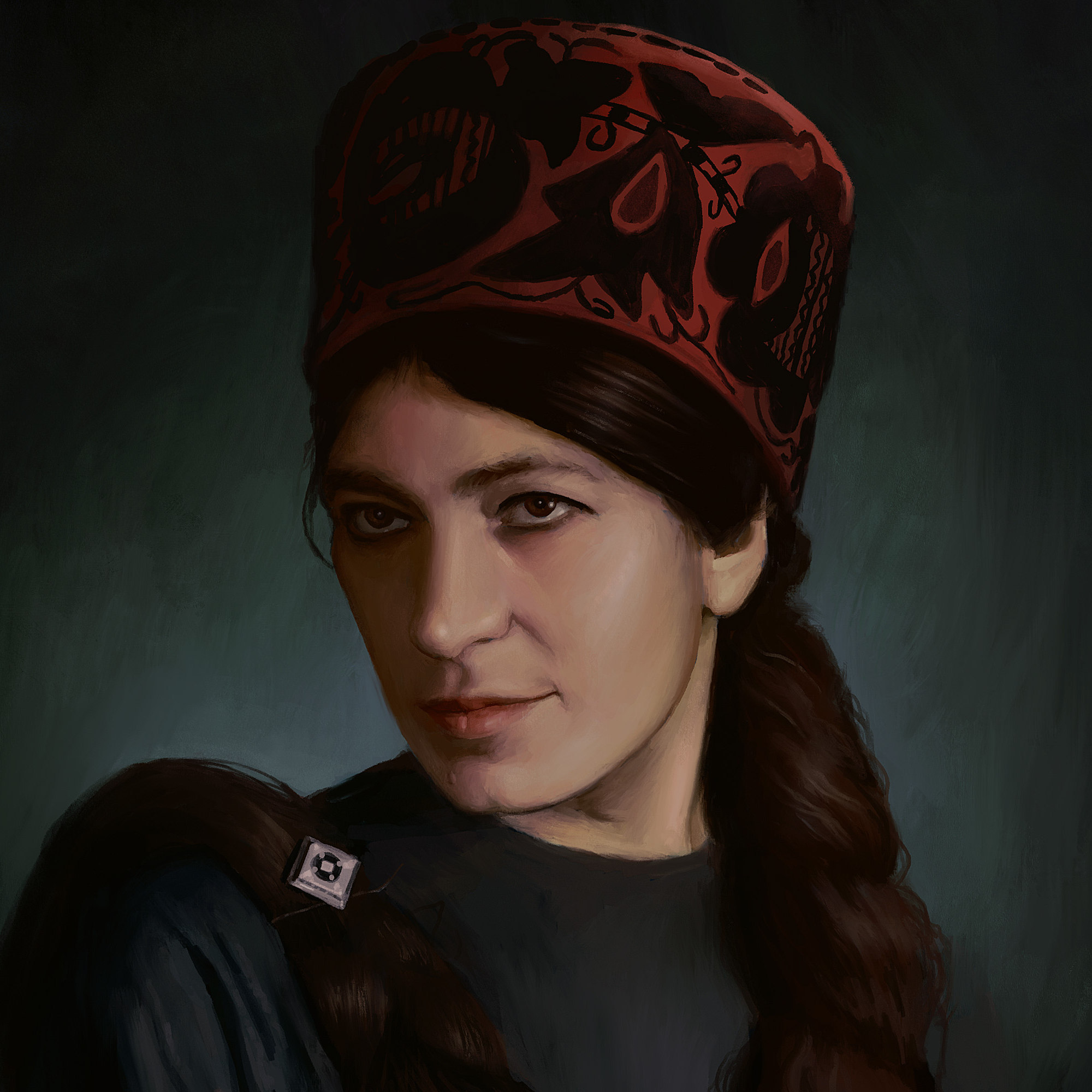
The young Panchenko resembled a young lady from Gogol's Viy. “Her stylized Ukrainian dress, long, tight, and black as pitch braid, a beaded ribbon above her forehead — all this aroused admiration in many,” Mykola Plakhotnyuk wrote in his memoirs. Once, art critic Vasyl Skuratovsky brought Panchenko a baby crow that had fallen out of its nest, and she nursed it and tamed it — a black-haired beauty with a crow on her shoulder.
Lyubov's husband, artist Oleksiy Oliynyk, was initially delighted with his wife and her work. He built a house with an attic, dug a pond, and built a boat. However, something went wrong in their relationship, and over the years, the couple spent increasingly more time apart.
When her husband died, Lyubov was left alone. The couple will be reunited after death: in the Yablunsky cemetery, under a shared gravestone with an image of a bird by Panchenko, so that it is immediately clear that this is the final resting place of artists.
**
She was in her early thirties when people from her immediate circle were taken away one by one by the USSR's repressive machine. Then Mykola Plakhotnyuk, Vyacheslav Chornovil, Ivan Svitlychny, and Vasyl Stus were arrested. The circle was narrowing.
Panchenko suddenly fell ill and was hospitalized (unexplained, serious illnesses — another pattern in the ornament, permeating her life story), experienced clinical death, and immediately after that, interrogation by the KGB. Since then, she has been ill a lot. In the last photos, she is no longer a Gogolian young lady, but rather a witch who has mounted Khoma — and a helpless one at that. “She was never good at housekeeping, and even less so in her old age,” her neighbors would recall. Panchenko stopped cooking for herself and lived in a house without sewage or running water. The artist's friends attempted to persuade the local authorities to improve her situation, arguing that she was entitled to this as an honorary citizen of the city and a person with a disability. And improvements were made, but only to appease them. For example, when Panchenko finally got sewage, the toilet was placed right in the middle of the kitchen, closer to the table. When guests came, she covered it with a rug.
After living in occupied Bucha without any food supplies, Panchenko did not recover. It is not known exactly what happened to her that month and how she managed to hold out for so long on her own. A shell hit the artist's barn in the yard, and the blast wave knocked out the windows and damaged the front door. When she lost consciousness, her faithful dog Bonya ran to the neighbors to call for help. Panchenko was evacuated to a hospital in Kyiv. She was unconscious for a long time, did not speak, and did not respond. But her loved ones visited the artist, and Olena Lodzynska also came: she brought daffodils and told stories about common friends. The artist reached out for the flowers, began to answer questions, and gradually started to eat. She said that Russian soldiers had knocked on her door, but she did not open it and snapped at them, “I don't want to hear or see anyone!” Surprisingly, they left.
But after living under occupation, the artist's health improved only briefly. On April 30, 2022, Lyubov Panchenko passed away.
**
"Unfortunately, Panchenko did not have her own school. She did not teach, and her works could not be seen anywhere. She simply did not have time to make an impact, and this was the case with many artists who belonged to the Sixtiers generation. She was not allowed to practice her craft freely: everything remained her dreams, projects, and ideas," Oksana Semenik says.
This is sad: immortality, if it exists, has many forms — one of which I would very much like to find for the artist from Bucha. And even if she had no followers, her indirect influence can still be seen today: for example, in the trends of mixing contemporary clothing with ethnic Ukrainian styles, or in the beauty of Ukrainian beaded necklaces, syliankas and gerdans, worn alongside everyday outfits.
Sometimes, in order to be reborn, an artist must die: then death itself becomes their agent. This is what happened with Panchenko: people started talking about her, her works appeared on all kinds of merchandise — tote bags, scarves, T-shirts.
“Did you come to talk about Lyuba?” I hear a voice from the yard when I press the doorbell at the gate. After Panchenko's death, her neighbors got used to journalists and people eager to see the artist's house. They recall that when guests came from abroad, the interpreter would give instructions: 'Don't say anything bad.' However, they had a lot to say, mostly about the local authorities, who they claim did not care about the fate of the artist, an honorary citizen of the city, either during her lifetime or after her death. They also say that the story of Panchenko's starvation in occupied Bucha is exaggerated: neighbors who remained under occupation brought her food and tried to help. Yes, it was cold and difficult; there was no heating or water, but she was not left to fend for herself. Whatever happened, the occupation had a tragic impact on the artist's poor health.
The artist's house is easy to recognize: among the well-kept yards around it, it stands out for its neglect — a hedge instead of a fence, an overgrown yard, thick ivy engulfing the attic, once built by Oleksiy Oliynyk as a workshop.
A sign of recognition that Panchenko did receive after her death? — a street named after her in Bucha. On Google Maps, it still has its old name, Dymytrova. In the twilight, I walk down this short street from beginning to end, looking for a sign with Panchenko’s name on it, but I can't find any with the artist's last name — all street signs still bear the name of the Bulgarian communist.
**
The Museum of the Sixties plans to hold an exhibition of Panchenko's works and publish a catalog of her linocuts. The only album of the artist's works was published after her death, in 2023 (when you visit the publisher's website, the first thing you see is a pop-up window saying: “We are working! Kharkiv is standing!”). Fortunately, the artist managed to see at least the layout of the album during her lifetime. The moment when Panchenko would have held her album in her hands after decades of selfless creativity could have been a moment of justice, when a person receives what they deserve while still alive. And this opportunity is lost forever.
Lyubov Panchenko was born in the village of Yablunka (now part of Bucha) in 1938. She graduated from the Kyiv School of Applied Arts (embroidery department) and later attended evening classes at the graphics department of the Ivan Fedorov Ukrainian Polygraphic Institute. She worked as a fashion designer at the Design and Engineering Technology Institute and at the Republican House of Models. Her creative work includes a series of watercolor sketches, clothing designs, linocuts, collages made of coat fabric, and embroidery samples (published in the magazine “Soviet Woman”). In 2023, the publishing house “Publisher Oleksandr Savchuk” released the first album of her works. She died in the hospital on April 30, 2022, after a month of living under occupation. She is buried in Bucha, at the Yablunsky Cemetery.