This audio is created with AI assistance
My child and I are lying in sleeping bags. The temperature in this room is twelve degrees above zero; in the others, it is six. We depend on hot water bottles and each other’s hugs. And on humour. We’re rewatching the old TV show ALF on my phone. In one episode, Willie — the father of the family that, by chance, ends up hosting an alien — exclaims, “God, why are you putting us, ordinary people, into such extraordinary circumstances?”
“Oh, tell me about it,” my daughter mutters with irony from inside the sleeping bag.
A few days ago, water was streaming from the ceiling into this very room — the municipal services were attempting to restore central heating, but the pipes had frozen. Several books got soaked, as did the piano my daughter loves to play “Shchedryk” on, along with the toys resting on top of it. Among them is a plush Taras Shevchenko that my daughter made a few years ago. Now he lies on a towel, drying; his damp hair and moustache have curled and fallen limply to one side.
“Not feeling so well, are you, Taras?” my daughter says to him. “The years go by, and still the Russians won’t leave you in peace? I get it.”
It is cold and dark inside the apartment. There is no hot water, and at times the mobile connection and the internet cut out as well. Our plants have begun to wither and die. It is difficult to manage household chores and work, make plans, and remain optimistic. All of this is uncomfortable and draining. In the evenings, when the darkness outside and the darkness inside become almost impenetrable, the sense of misery feels especially acute. Even the Christmas lights strung around the apartment offer little comfort.
“Why don’t the women and children leave Kyiv?” people online ask — a logical question. I don’t have a rational answer. Because it is our home. Because our people are here. Because to me, Kyiv is like a friend or a family member — when it suffers, I feel the need to be close, even if there’s nothing I can do to help. Because the cities closer to the front line, on the front line, or under Russian occupation have endured far worse, for far longer. We, meanwhile, simply have to hold on a little longer and it will get better. We carry this quiet, stubborn resolve: we will get through this. The knowledge that our spirits remain unbroken brings a measure of comfort, no matter how high a price we are paying for that strength.
During these dark and cold days, we spend a great deal of time walking the city streets. Movement makes you feel warmer. Seeing that, despite everything, the city is trying to go on living its usual life makes you feel warmer, too. The young barista at my favorite coffee kiosk, wrapped in a parka, beanie and gloves, hands me my coffee and smiles: “Have a nice and peaceful day! Everything will be okay!” We buy disposable heat packs — a few for ourselves, and several for the homeless people who sleep in the underground passage. In a pet shop, we get some feed for the city birds; there is an irresistible urge to care for others.
My friend recently received a gift from a colleague at work: a fire-resistant brick, the trendiest home-heating device these days. We joke about how quickly our wish lists have changed. When the cold first set in, she and I even wandered through outlet stores in search of “death pajamas.” It’s dark humor — we have no intention of dying in them, but we understand that if our building is hit and we have to wait for rescuers beneath the rubble or run outside in an instant, we need pajamas that are not only warm and comfortable, but also look decent. The “death pajamas” turned out to be a great purchase: they are perfect for sleeping when the apartment temperature does not rise above 10°C.
I am amazed at how quickly children adapt to extreme conditions. There are no complaints about the cold or the darkness. Only sometimes, when the explosions are especially loud at night and we decide to go down to the shelter, my daughter says, “I’m so tired of this. The Russians are stealing my childhood.”
“Would you like us to go to another city for a while?” I ask her.
“No,” she sighs. “I just want there to be no Russia.”
Her girlfriends come over for sleepovers — of course, bringing along their sleeping bags and warm pajamas. No cataclysm can stand in the way of a girls’ night in. By the light of flashlights, they play games and laugh and make jelly that sets right there in the cold room — very convenient. At night, Russian drones are shot down over Kyiv, but the girls sleep soundly; they have long since grown used to those sounds.
Daily life now follows a different rhythm, shaped by entirely new concerns. You think about when and how to wash clothes, where and when to wash and dry your hair, how to charge your gadgets, what to cook for your child that is quick and easy, how to organize their leisure time in the cold without electricity and how to coordinate plans so that someone is always at home — because water has already leaked from the ceiling twice and because, if the power suddenly returns, you need to plug in everything to charge. You constantly consider what else you can do to keep both people and plants from freezing in the apartment.
In such circumstances, even the smallest reasons to be happy are treasured. Some people throw parties by the Kyiv Sea [an informal name for the Kyiv Reservoir, a large artificial lake on the Dnipro River north of Kyiv — Ed.], some organize neighborhood picnics in the courtyards of high-rise buildings, some buy garlands, books or delicious tea, visit friends or invite guests over — and some, like my child, upon seeing that the lights are on in our building, joyfully shout to the whole street: “Hurray! We’ll be taking the elevator!” The fact that Kyiv residents find joy and create celebratory moments does not mean life here is easy or simple. It means that, amid all this darkness, we choose light. We choose to live in the here and now. And we choose to stick together — to help one another, to support one another, to care for one another.
Russia is attacking power plants and heating stations; Russia is targeting the most vulnerable among us. It is especially hard on the elderly, those with limited mobility, the sick, and families with infants and young children.
No stone walls can shield us from the darkness and cold. Yet we are managing to build other “protective walls” — walls of mutual support, compassion and empathy.
“Come over for the night,” our friends message. “We have heating, hot water, electricity and even some Chicken Kyivs.”
Every day, I read messages from friends, acquaintances and even strangers. They invite us to stay for a while, spend a few nights, or at least warm up for a few hours. They invite us to come to another street, another town, another country. They write that they’ll be happy to have us. We’re not leaving yet, but the thought that there are people ready to take us in — that we are not alone, that there is somewhere to go — warms our hearts and somehow brings a sense of calm. We can feel how all these words of support form an invisible protective barrier that hopelessness and loneliness cannot penetrate.
There is a package waiting for us at the post office. Our friends from Poland sent thermal underwear, warm vests, disposable heat packs and sweets. They’re worried about us. I struggle to find the right tone to tell them about life here — I don’t want it to sound like bravado, but at the same time, I don’t want it to come across as whining or complaining. I want to convey clearly the situation in Kyiv, how we are coping, and why we are still here. We unpack the parcel, and I start to cry — it’s deeply moving. Such acts of care and support turn out to mean far more than I realized. And I write to my friends just as I feel it: with bravado, with whining and with dark humor.
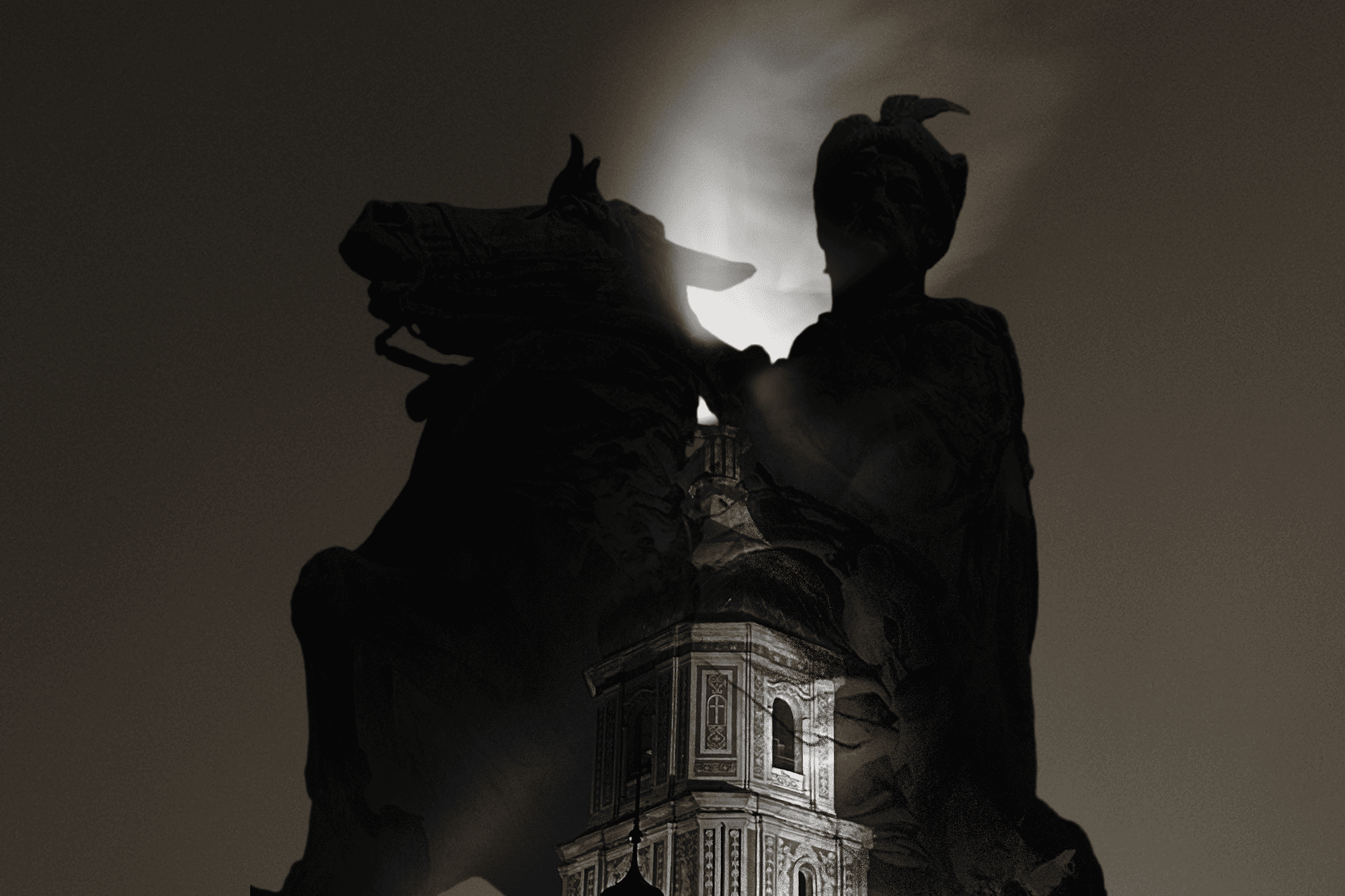
I have a personal life hack for the hardest times. When everything becomes unbearable, I go to St. Sophia Cathedral. I touch its walls from the outside, then step inside, into the Metropolitan Garden. Here, you can feel the remarkable effect of timelessness. The thick walls muffle the city’s noise; it’s like lying on a feather bed. You feel so small, and the bed so immense. Here, you realize that these walls have witnessed and endured countless terrible, difficult and unbearable periods. They have seen history unfold. They have endured. And Kyiv has endured. And it will endure now. Even our dark times will become just one of the hundreds of stories of Kyiv. It is comforting.
We return home along dark, slippery streets. I hold my rosy-cheeked, happy child by the hand — she slides on the ice. “It’s so cold,” I say. “I can’t seem to get warm.”
“We just need to hug really tight!” my daughter exclaims, and immediately does just that. A generator hums outside one of the cafés, so we dash in for hot tea and cocoa. In the window, a quote from Artem Chekh’s book “District ‘D’” reads: “People need people.”
Could there be a more accurate and concise description of our lives today?
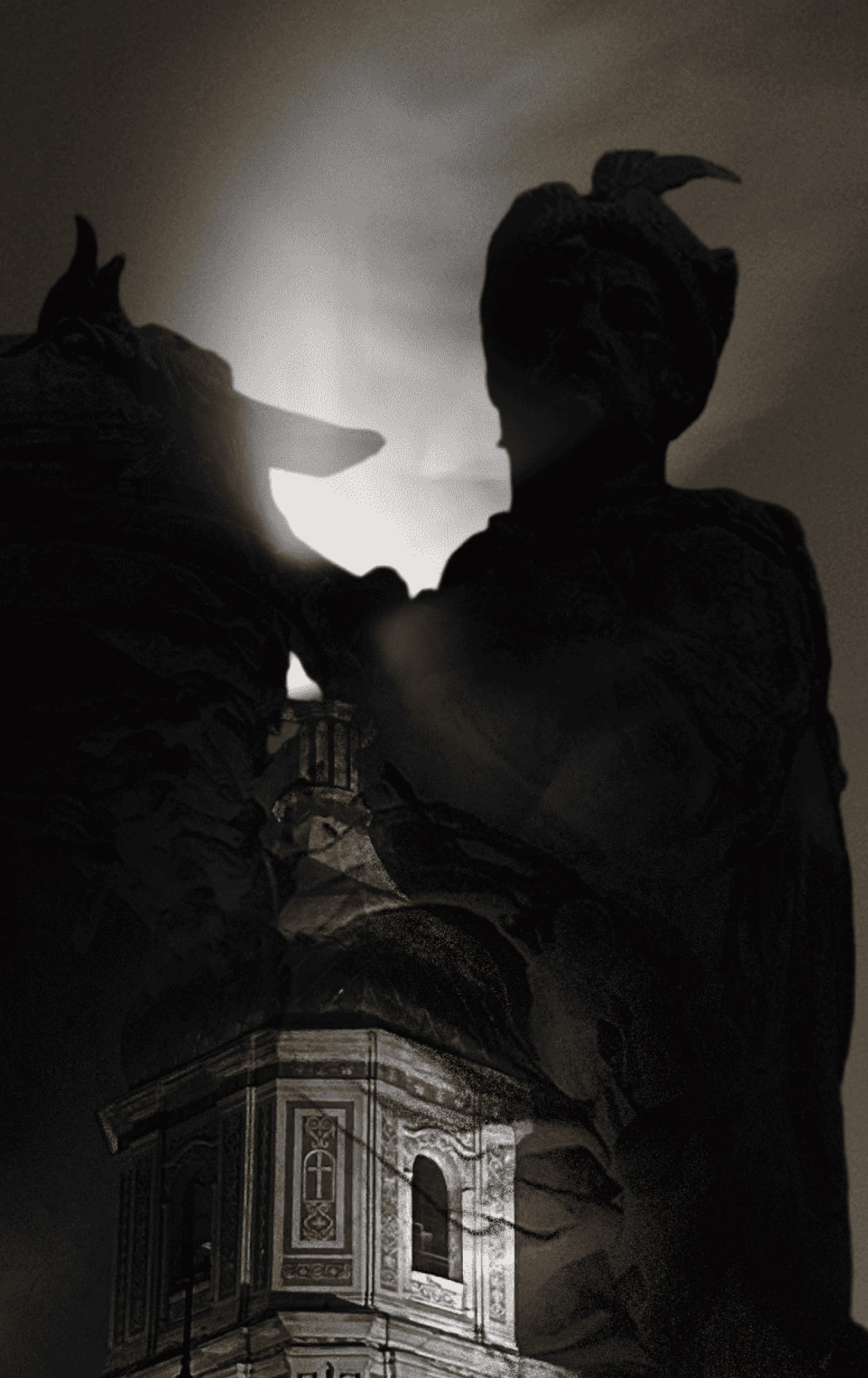
Illustration by Vadym Blonskyi
Translated from the Ukrainian by Liubov Kukharenko