My grandmother was made entirely of metal. She had just turned 17 when the Germans invaded her village. She hid in the attic so she wouldn’t be “taken away for work.” They didn’t find her then, but a few weeks later, she was caught in a field, put in a cattle car and taken to Germany. She escaped en route, hundreds of kilometers away from home, and walked all the way back to her village. Grandma used to say that everyone had a hard time during the war, and that she got lucky. She fed stray cats until the day she died. Grandpa didn’t like it, but she fed the cats anyway.
But this piece isn’t about her.
Somehow, over the past month, two people I know started feeling trembling in their hands during aerial attacks. They didn’t use to, but now they do.
I know this because they told me. Everyone knows that I shake during attacks, so people tell me these things. One shelling in Donetsk Oblast shook me up so completely that it has never let up since. You could say I’m an ambassador for people who shake during aerial bombardments.
And so, over the past month, two friends have written to me. And both began with the words: “I don’t understand why this suddenly happened to me.” That’s what both of them said to me.
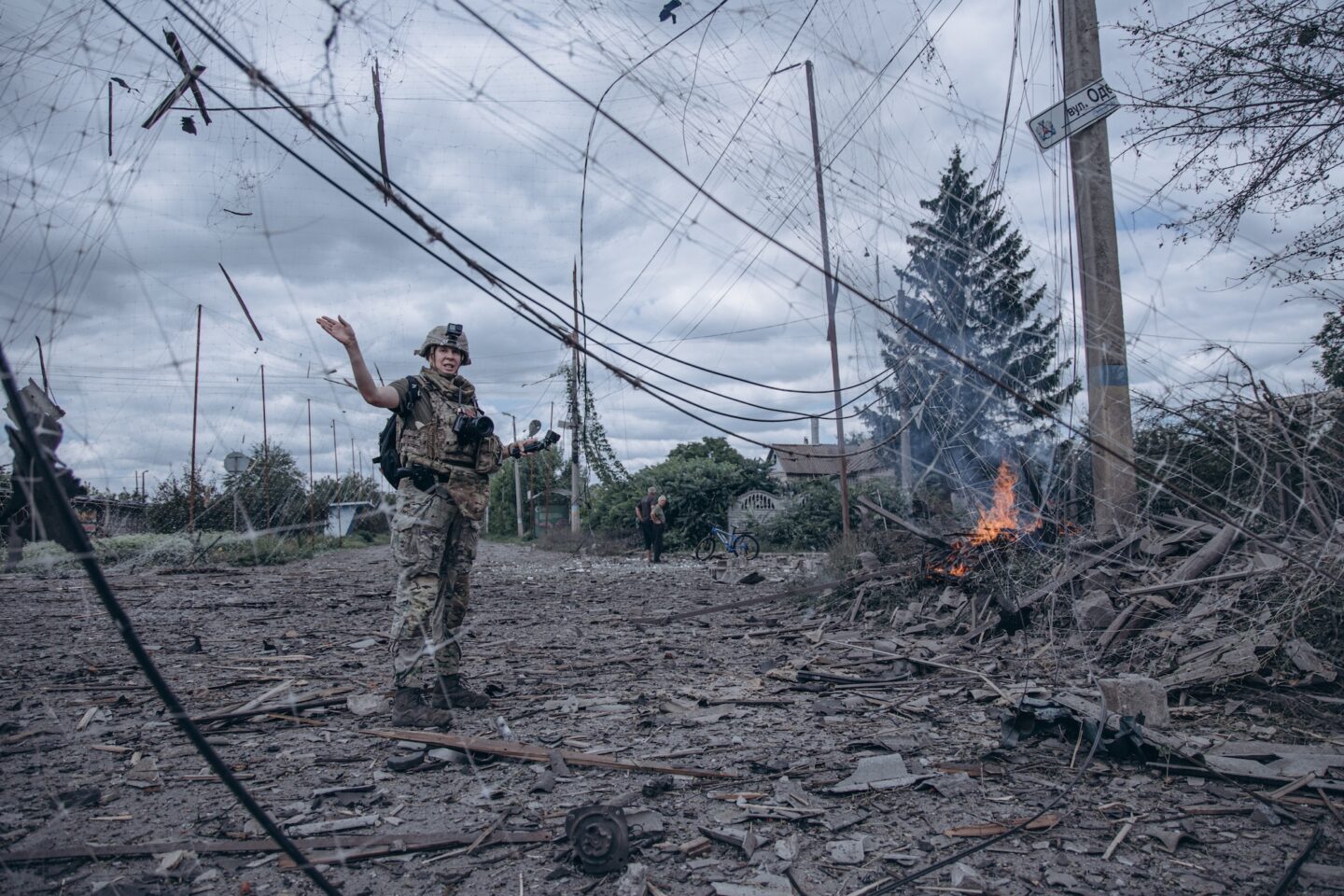
For five years, the Russians have been bombing these women and their children with drones, missiles, missile drones and drone missiles. They threatened them with a nuclear strike. For the first time in human history, they launched a medium-range intercontinental ballistic missile. They tried to besiege them. They threatened them with a nuclear strike. They tried to freeze them out in the middle of winter by destroying their power grid. They shelled the dam to flood two districts of their city. They threatened them with a nuclear strike. They tested on them every available technology for delivering explosives over a distance of more than 300 kilometers. They organized terrorist attacks. And, once again, they threatened them with a nuclear strike.
On the night of July 6, the Russians launched 37 ballistic missiles at Kyiv — the largest number of ballistic missiles ever fired at a single city in a single attack. The previous “world record” was 28 ballistic missiles, which struck Kyiv on the night of July 2, 2026.
And then Valia texted me: “Everything was fine, and then, ALL OF A SUDDEN, something happened to me. Everyone else is asleep at home; I’m the only one who’s feeling kind of on edge.”
I have a colleague from Germany, a German woman. Last week, she sent us an email saying she wouldn’t be able to review the report on time because construction work had started near her office. “The construction workers’ schedule overlaps with ours, and the noise is distracting us, so we’ll have to postpone the deadline,” she wrote. I opened this email at night while working with my Ukrainian colleague. We work at night to meet deadlines.
The women I know “pull themselves together” after an attack, drop their children off at daycare and go to work. Because they have to feed their children and also pay for private daycare with a shelter if the public daycare doesn’t have one. The women I know sleep with their children in the hallways of high-rises, in underground parking lots, in the subway and in underground walkways. “Everything’s fine,” they say. “It was loud, but everything’s fine,” say the women I know after a record number of ballistic missiles were just fired at their city. And if their hands are shaking, they’re surprised and even blame themselves for being weak. After all, everything is fine.
My grandmother’s name was Dina, according to her passport, it was Anisia. That was common back then. Her parents liked the name Dina, but their preference didn’t matter. She was registered “as required,” that is, according to the church calendar. That’s why my grandmother had two names. When someone asked me my grandmother’s name, I’d say, “Dina, but her passport says Anisia.” The adults weren’t surprised; they just nodded in response.
And my grandmother was made entirely of metal.
Grandma Dina called me “kid,” just like she did all the neighborhood kids. Sometimes I doubted that she even knew my name. It really annoyed her when I went up to my loved ones to give them a hug. Once, Grandma’s sister came to visit, and I sat on her lap and hugged her. Grandma Dina yelled at me: “Get down, don’t embarrass yourself — you’re a big girl already!” I was seven. She was very worried about me getting spoiled. When I cried, she’d say to my mother, “See? You’ve spoiled her — how is she supposed to survive this life?”
Grandma Dina fed stray cats. Grandpa didn’t like it, but she fed the cats anyway. And when she went out to feed them, for a few minutes, she became a different, unrecognizable woman. At first, with her usual expression, she scolded them for causing trouble, and then, as they ate, she began to smile slightly, stroking their thin, fluffy backs. She would rest her hand on her hip, lean down, run her hand over each cat once or twice and smile. Then she would take the bowl away, straighten up, and her face would return to its usual expression.
One morning, I found the body of a big gray-eyed cat under a bush — one of the cats that had been visiting my grandma my whole life, for 10 years. He must have died of old age or illness. I started crying and ran to my grandma. She twisted a towel into a rope and hit me on the side: “Stop wailing — you’re a big girl now!” That evening, when Mom came home from work, I said, “I think our grandma is a robot.” Mom replied, “Don’t be silly — finish your soup.”
Grandma Dina was made entirely of metal, with no soft parts at all. If she had lived to see today, she wouldn’t have had to adapt. She knew how to pull herself together. She didn’t know how to communicate with people, but she sure knew how to pull herself together.
As I now understand, she had no right to feel compassion for herself, and therefore she did not feel that compassion for others. She found compassion dangerous.
We truly can no longer afford such emotions, such compassion, as we did before the war. We wouldn’t be able to survive like that, let alone work. We don’t write emails about uncomfortable working conditions, as that German woman did.
Moreover, life during wartime starkly contrasts our reality with Instagram “selfie culture” — the cult of the self and self-realization under the motto “I owe nothing to anyone.” Fashion blogs about “success, resources and self-determination” are irrelevant to people whose apartment has no heating and who have to care for a sick child.
The daily deaths and the brutality of the Russian attacks have changed us all irrevocably. Ukrainian women have built up a layer of armor over their skin. They are fighting, living under daily attacks, working and caring for their families despite everything.
But if it were possible to choose, I’d want to keep my soft little belly. I’d want to hug people, hold them close and feel the warmth of their hands.
Grandma Dina would have said I wasn’t ready for this life. But I believe that love is worth the risk.
Translated from Ukrainian by Liubov Kukharenko
Read more
My Grandmother Built Airplanes
As a child, it surprised me that not every family had a grandmother like mine
Thinking about Europe from Ukraine
Do they fully realize what is at stake?

Following the Traces of the Golden Slipper
The photo series by Elena Subach and the Cinderellas we never noticed