‘What If the Roof of Westminster Abbey Were Burning?’
Charlotte Higgins, Chief Culture Writer for The Guardian and author of “Ukrainian Lessons,” on translating experience and the art that will shape the memory of war
Olesya Yaremchuk, Julia Kochetova
22.07.2026
Olesya Yaremchuk, Julia Kochetova
22.07.2026
Charlotte Higgins is the Chief Culture Writer at The Guardian. Four of her six books explore the ancient world. “Under Another Sky” (2013) is a journey through the Roman past of Britain; “Red Thread” (2018) explores the metaphor of the Maze. Her most recent book was “Greek Myths: A New Retelling” (2021).
Higgins first traveled to Ukraine in September 2022. Since then, she has returned again and again, reporting on Russia’s war against Ukraine through the lens of culture. She has written about writers, poets, filmmakers, playwrights and artists, arguing that the literature and art created by these people — including those who lost their lives because of the war — will shape how this war is remembered.
“They worked delicately and sensitively, moving beyond official narratives and mapping the fragile, complicated terrain of emotion. They found a language — whether verbal or visual — to express what had seemed impossible to express.”
Partly as an INDEX: Institute for Documentation and Exchange Fellow, Higgins completed “Ukrainian Lessons” in 2025-2026. The book will be published in English in August 2026 and in Ukrainian in May 2027. In this conversation, she reflects on writing about war, Ukrainian rage and grief and the Ukrainian Cassandras whom the world hears — but still struggles to believe.
This interview was made possible thanks to the support of The Ukrainians Media patrons — hundreds of people who believe in independent, high-quality journalism. Consider joining to help us create meaningful content.
You came to Ukraine not as a war correspondent, but as a cultural critic. Yet you chose to remain bound to this country for years. What influenced your decision to stay with Ukraine during the war?
On my first trip, in October 2022, I met a huge number of people. I felt that I had only scratched the surface. There were so many threads I wanted to pull on, so many stories I wanted to tell, and I simply couldn’t contain all of that in one trip. One of those people was Victoria Amelina.
I think the reason I came back for a second trip was really Victoria. After returning from Ukraine, I wrote an article about poetry being written during the war, and she was one of the people I spoke to. We had a long conversation at the end of 2022. Then, in January, she said to me: “I really think The Guardian should publish extracts from Volodymyr Vakulenko’s diary.”
I replied: “We can’t just publish extracts. We have to explain the story.” That was how the idea emerged of doing a proper piece about Volodymyr Vakulenko. We discussed how to approach it. I said: “There are three options. Either you write something, or we write something together, or I write it, and you become one of the characters in the article.” Victoria chose the third option because she was always planning to tell Volodymyr Vakulenko’s story in her own way, in her own future book.
By the time of my third trip, I think I had convinced The Guardian that I was effectively part of the reporting team covering Ukraine. Sending an arts journalist to report on a war no longer seemed quite such a strange or eccentric idea.
You studied ancient history, literature, philosophy, Latin and Ancient Greek at Oxford. In your writing, you often return to the storytellers of antiquity — Aeschylus, Sophocles and Euripides — whose works shaped how later generations understood war and its impact on individuals and societies. Yet in your reporting on Ukraine, you chose to focus on culture, one of the key elements of Ukrainian identity. How much, in your view, can culture tell us about war?
In this particular war, it is absolutely obvious that culture is one of the central battlegrounds. That has been clear from the beginning. Putin literally wrote an essay about the history of Ukraine and Russia in which he laid out a series of arguments that almost everyone in Ukraine would regard as false and deeply misleading about Ukrainian history and identity.
When the aggressor openly says that the war is about culture, it seems entirely logical to pay close attention to that aspect of the conflict. Wars are usually reported through military, political and economic perspectives. Increasingly, journalists also tell stories from behind the front lines: about families, communities and, often, women. We know that sexual violence is, tragically, part of many wars. All of these dimensions are covered much more fully today. But culture rarely occupies a central place in how journalism approaches war.
I’m certainly not suggesting that frontline reporting is less important. It is obviously vital. But I increasingly felt that culture is one of the most powerful ways of understanding any geopolitical moment, any society, any historical period. If you ignore culture, you miss an entire layer of what is happening within a society, a historical moment.
I always knew that culture would help me understand this war and, crucially, help readers understand it as well. This war is deeply bound up with history, identity and language. What I did not fully anticipate was how looking at the world through poetry, theatre and art would bring me so close to people’s emotional lives — to emotions that are raw, painful, contradictory and deeply personal.
Perhaps I should have anticipated it, because that is precisely what art does. But I did not realize that conversations with artists, poets, playwrights and musicians would open up this entire emotional landscape of what it means to live through war. For me, this matters enormously. Not only because human emotions themselves are significant, but because empathy depends on them. How else can people who have never been to Ukraine understand what is happening here?
The closer you can get to a person’s inner life — to what it actually means to live through war day after day — the more empathy and understanding can grow between people.
In your book, you write that “The Iliad,” the first great poem of war, begins with the word “rage”: “Rage — Goddess, sing the rage of Peleus’ son Achilles.” This emotion drives the entire poem. The Greek word is mênin. At first, it is the anger of a warrior humiliated by his commander. Yet rage becomes the fuel of the poem itself. What emotions accompanied you during your journeys through Ukraine?
I turn to the ancient Greek poets in this book for two reasons. First, because they wrote about war in extraordinary ways. They gave me a framework through which to think about how people in Ukraine are writing about war today. But there is another reason. These poems and tragedies are very close to my heart. After spending time in Ukraine, I reread them differently. I felt that I understood Achilles’ rage a little better. But perhaps I also understood Ukrainian rage a little better because I had read “The Iliad.”
Rage is an extraordinarily difficult emotion. For an outsider, Ukrainian rage can be overwhelming because you have not experienced the terrible things that produced it. In some sense, returning to ancient poetry became a way for me to make sense of that emotional world. At the same time, it is important to remember that Achilles’ rage is not something admirable. He is a profoundly difficult character.
The deeper force that drives the second half of “The Iliad” is the rage that grows out of grief after the death of his closest companion. It was that intertwining of grief and rage that I recognized in the writing of many Ukrainian authors. I felt I understood their work better when I placed it alongside Achilles’ experience — his grief and his rage.
And again, I should emphasize that Achilles’ rage is really beyond human, it exists in a world of myth. I am not suggesting a direct comparison. These are simply the associations that arose in my mind.
And what emotions did you experience personally in Ukraine?
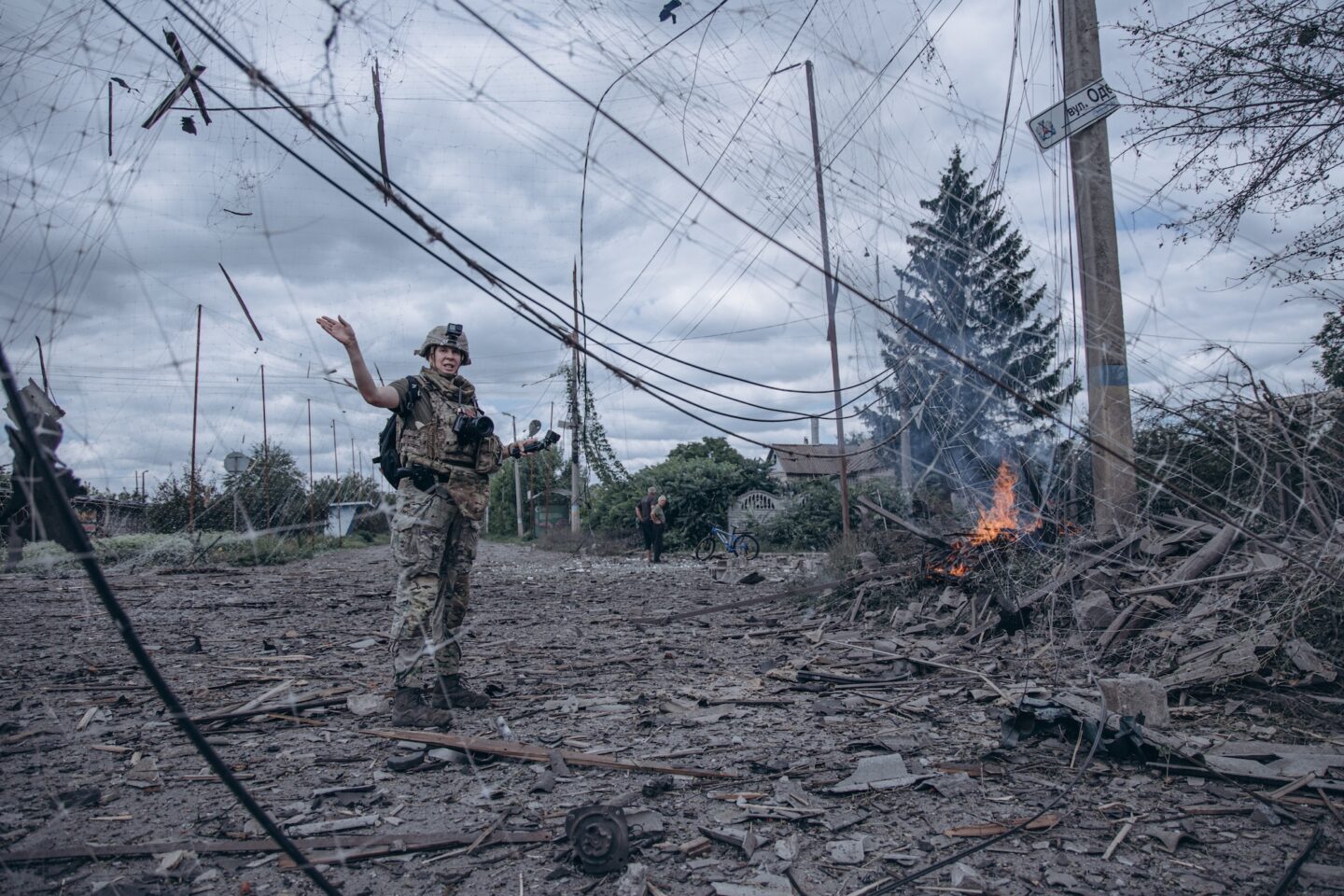
I remember my first day in Kyiv. It was October 10, 2022, the day of the major missile attack on the city. Since the Russian withdrawal from Kyiv Oblast, there had been nothing like it. When it happened, my first thought was not: “Am I going to survive?” It seemed clear that I probably would. I wasn’t especially frightened.
What I was frightened of was being unprofessional. So I remained extremely calm and prepared to work in circumstances that were completely unfamiliar to me. Instead of writing about poetry, I found myself writing about missiles and explosions. I kept telling myself that I had to stay calm, that I needed to maintain some professional distance from my own emotions.
That lasted for quite a while. But eventually I had to make room for my feelings, because it is impossible to remain human and feel nothing. I experienced many emotions. Anxiety. Stress. It was profoundly painful to listen to people’s stories.
My journalism had never required anything like this before. I was already in my fifties, and I had never sat opposite someone and asked what it felt like after their child had been killed. This was certainly not an emotionally neutral experience for me.
If I am honest, I felt a great deal of sadness. I feel like a whole dimension of myself opened up into an emotional world I had never inhabited before.
Were there also positive emotions?
Yes. In fact, there were a great many. I’ve been extraordinarily fortunate to find such remarkable friends in Ukraine. We’re sitting now in the offices of INDEX: Institute for Documentation and Exchange, where I was a Fellow last year and where I was able to work on “Ukrainian Lessons.” It became much more than simply a place to exchange ideas. It was also a community of mutual support and friendship. I feel enormous affection for my friends in Ukraine — people I admire, care about and worry about.
The photographer I work with most often, Julia Kochetova, has become very dear to me. There are also Artem Mazhulin and Mariana Matveichuk, who have worked with me as producers, translators and fixers. I admire them enormously and care about them deeply.
In the description of this year’s symposium, The Most Documented War: Polyphony of Stories, the researcher Natalia Otrishchenko refers to the siege of Troy, which we know through Homer’s account. “The story of the Trojan War has come down to us in the form of a great poem. We know about Achilles’ battles and Odysseus’ cunning, but we know very little about what the city itself lived through during those ten years.” In your view, what is most important about documenting the war in Ukraine today? And how did you find your own documentary language?
It is relatively easy to write that such-and-such happened: there was an explosion, the roof of a cathedral caught fire, a drone struck an apartment building, five people were killed. What is much harder is to convey the texture of experience — to explain what these events actually mean for the people whose lives they have touched. I’m thinking of readers who live at a distance. How do you make that experience meaningful to someone thousands of miles away?
Personally, I try — and I’m sure I don’t always succeed — to be as attentive as possible to detail: to small nuances, to the way people behave, to seemingly insignificant moments. I believe in the power of specificity. The more carefully and precisely we choose our words, the greater the chance that we can truly carry experience across.
In a sense, journalism is an act of translation. You’re not translating words — you are translating experience. You’re carrying precious cargo: knowledge, memory, lived experience. The challenge is to hold all of that inside a piece of writing and then pass it on to someone else in a way that allows them, at least partially, to understand it.
Earlier today, I was recording a podcast with a colleague, and we were talking about Kyiv Pechersk Lavra — a place of immense importance to Ukraine and to Eastern Europe, but one that most people in Britain know very little about. My way of explaining it is to translate that experience inwardly into something familiar to me. I ask myself: What if the roof of Westminster Abbey were burning? Or St Paul’s Cathedral?
After all, British history contains exactly those memories. You don’t have to go back very far. London burned during the Second World War.
So I’m constantly trying, on the one hand, to translate Ukrainian experience into coordinates that are familiar to me and, on the other, to remember my own history. For example, I think about the park I walk through every day on my way from home to the office. That entire neighborhood was heavily bombed during the war, and the park itself exists because of bomb damage. In British cities, the landscape of war is still there — it simply lies beneath the surface.
So I’m always looking for points of connection: something that links people’s experience here with peopleʼs experience elsewhere and helps carry that experience from one place to another. You chose a quotation by Mike Nelson as the epigraph to “Ukrainian Lessons.” He says that making a work of art requires “matter,” which the artist reassembles and almost casts under a spell. He also compares matter with language. How has working in Ukraine changed your understanding of language, especially as you’re now studying Ukrainian intensively?
I chose that epigraph very intuitively. I’m not even sure I can give a completely rational explanation for why. But if you ask me what art is, I think Mike Nelson gives a wonderful answer. He suggests that art begins with things that already exist in the world. The artist takes those things, rearranges them, and adds something else — something that transforms them into art. There’s something almost magical about that process. It’s what great writers do with language and with material.
But what touched me most wasn’t even that idea. At the beginning of the quotation, Mike Nelson says, “You need empathy and a good heart and soul.” That line stayed with me because it reminded me of the finest art I’ve encountered in Ukraine. It has empathy. It has a good heart. It has soul.
If I understand correctly, you’ve been learning Ukrainian for about four years?
Approximately. That’s just shaming, because my Ukrainian is still so bad. After my first trip, I decided that if I was going to keep coming back, I didn’t want to remain completely isolated. The idea that I couldn’t say anything beyond “hello” and “thank you” really bothered me. At first, it took me ages simply to decipher signs on buildings.
I’d studied difficult languages at university, so I told myself, “Come on, surely you can do this.” I didn’t want to depend entirely on other people. I wanted to be able to find my way around a Ukrainian city without feeling completely helpless. I wanted to ask someone how the ticket machine in the metro worked, buy a ticket to an exhibition or simply exchange a few words with the person at the hotel reception. I wanted some foundation for communication. And then, more ambitiously, I realized that language is a fundamental part of culture.
I thought: one day I’d like to read the Ukrainian poetry I’m writing about in the original. Now I can read some Ukrainian poetry — with help, of course — and that feels like a huge victory. I can find my way around a city, order food in a restaurant, and have a simple conversation. Even though my progress is painfully slow, learning the language gives me a sense of freedom.
One of the poems in “Ukrainian Lessons” is my own translation of Iryna Tsilyk’s poem “My Day.” I’m very glad that I was able to translate it myself.
Could you draw Ukraine? (In the introduction to your book, you write that you couldn’t have done so before.) Tell us about the places you have visited and how the geography of your knowledge of Ukraine has gradually expanded.
Much better than I could have before. I’m almost embarrassed to say that my knowledge of Ukraine has expanded from virtually nothing to something much more substantial. The only thing that gave me the confidence — or perhaps the arrogance — to think I could write about Ukraine at all was this: I might have known very little about Ukraine, but I knew a great deal about art and poetry. That was the foundation I could build from.
There is still one part of the country I haven’t visited: the north. I’ve been to Lviv, Ivano-Frankivsk, Odesa, Mykolaiv, Kharkiv, Izium and Sloviansk. I’d also love to go to Bessarabia, though I haven’t made it there yet. And I’d very much like to visit Zaporizhzhia, Sumy and Chernihiv. Those are still blank spaces on my own map of Ukraine.
In one part of your book, “Sing the Rage,” you write extensively about singing: “We sing to dull the pain of the loss of others: we sing songs of mourning, laments for the dead. We sing to mark this world with our presence, when the world becomes brighter and more defined because we barely outran death. We sing to prove we are alive.” What is the tone of the song for you in Ukraine right now?
I think what I wrote then speaks most directly to the early period of the war — although even saying “the early period” feels strange now. Who knows what stage of this war we are living through?
What became especially clear to me was that poetry is not some decorative addition to life. Its roots lie in the most fundamental human moments: gathering together, mourning, seeking comfort, celebrating joy or simply asserting that we exist. It was extraordinary to see so clearly that poetry fulfills these basic human needs.
One of the things that struck me at this year’s Book Arsenal was how much time has passed. This war has now lasted longer than the First World War. Entire publishing cycles have unfolded. Writers have had time to reflect on their experience in forms much longer and more complex than the immediate cry of grief or fear expressed in a poem.
Artistic responses to the war have become richer and more layered. This year’s Book Arsenal felt much more like a space for prose — for documentary prose, memoir and essays, often written by people who have come from the front, though certainly not only by them.
I think, for example, of the work of our INDEX Fellows: Kateryna Iakovlenkoʼs essayistic writing, particularly “Donbas as Metaphor,” and Anna Gruver’s reflections on home and loss. It’s odd to say it, but it seems like really interesting new forms are emerging from this war.
Hybrid, more textured forms that are trying to express one’s own experience or move more expansively through time and across landscape. I was saying in my podcast earlier, Ukraine has found new ways to fight the war. The nature of warfare has changed in this war. The nature of prose writing has also changed.
When you spoke with Oleksandr Mykhedin a Kyiv café during a gap between air-raid alerts, he told you: “I live with the feeling that I don’t have a past. I live with the feeling that I don’t have a future. I feel like my memories don’t belong to me.” War causes people to live in a constant, uncertain present. It becomes a mirror held up to the war, reflecting and refracting experience that otherwise seems to defy expression. How does this sense of time affect you personally — has your world stood still, or does it keep turning?
I have the privilege of living in a country that is not at war. That means my own experience of time is completely different. I have the privilege of planning my life. I can tell myself, “Perhaps in two years I’ll move house.” But reporting on this war has reinforced something I think I already understood but understand much more deeply now.
As we grow older, we realize that life is not a broad, level road. It isn’t a beautiful boulevard. It’s a tightrope. At any moment, you can lose your balance.
Disaster can arrive at any time. It doesn’t have to be war. It could be a serious illness. It could be something happening to your child. Life can suddenly turn upside down. I think I now live with a much sharper awareness of that fragility because I’ve seen, at close range, people whose lives changed overnight. And that is, in one way or another, the experience of almost every Ukrainian.
In your book, you write about Cassandra, the legendary prophetess who foresaw the fall of Troy. You write: “The pale Cassandras: resolute Ukrainian women, eloquent and truth-telling, who come to Western Europe and the U.S. to persuade, to present the facts and to make the case that Ukraine’s war is not far away, but it is here, right now.” Who are these Ukrainian Cassandras for you?
The people I had in mind were Oleksandra Matviichuk, Olesya Khromeychuk, Sasha Dovzhyk and Tetyana Teren, the dearly missed Victoria Amelina, and many others. In truth, there are many extraordinary Ukrainian women. What impresses me most is an entire generation of remarkably strong, articulate and determined women. Many of them are in their thirties or early forties — much younger than I am.
Their dignity, patience and perseverance in explaining Ukraine to the world, over and over again, without giving up, is deeply moving. I can’t imagine how exhausting it must be to spend so much of your life traveling, trying to explain Ukraine to people who often do not really want to listen. One of the greatest things I have taken away from Ukraine is precisely this admiration for the generation of Ukrainian millennial women. They are extraordinary.
Finally, what do you think Cassandra — the one whom nobody believes — is trying to warn the world about today?
I don’t really want to take this question out of the realm of poetry. Reading Lesia Ukrainka’s Cassandra alongside the ancient Greek texts — especially Aeschylus’ Agamemnon — was a revelation for me. Cassandra is not so much foretelling some distant future as describing what is happening in the next room. That, to me, is the essence of her message. The things we imagine to be far away are, in fact, much closer than we think. This is true both geographically and in time. Cassandra asks us to collapse those distances. She tells us: the terrible things happening over there are much closer than you realize. The tragedy is that no one understands her, and no one believes her.
If I were to put it more plainly — and I hesitate to do so because I don’t see myself as a geopolitical commentator — I would say that Britain is already living through a form of hybrid war with Russia. Most people simply don’t recognise it yet.
Druzhkivka: yet another town in Donetsk Oblast being erased from the Earth
Mykova Oliynyk
Oleksandr Glyadyelov’s Independence
For 35 years, Oleksandr Glyadyelov has been photographing one long story — a story about freedom and its price
Oleksandr Glyadyelov, Yaroslava Tymoshchuk
Vitalina Loved White Roses
How friends remember 20-year-old volunteer Vitalina Yarovenko, who was killed by a Russian missile. Continuation of Alex Babenko’s photo series
Alex Babenko, Mariia Mileiko
Думки
What I Dream Of
Thinking about the future, hoping for the future, fearing the future — these are uniquely human traits
Volodymyr Yermolenko, Vadym Blonsky
Calling Things by Their True Names
Hope is not assuming that everything will be all right. Hope is a deeply held belief that all our efforts have meaning
Oleksandra Matviichuk, Vadym Blonsky
Remain Partially Soft
On Ukrainian women who grew armor over their skin
Alina Sarnatska, Vadym Blonsky
Інтерв’ю
‘What If the Roof of Westminster Abbey Were Burning?’
Charlotte Higgins, Chief Culture Writer for The Guardian and author of “Ukrainian Lessons,” on translating experience and the art that will shape the memory of war
Olesya Yaremchuk, Julia Kochetova
Fiona Greenland: ‘Documentation serves to affirm that these works and people existed’
A researcher of cultural heritage on culture as a target and literature as a weapon
Ivan Haivanovych, Iryna Dzvonkovska
Jonathan Krause: ‘People may not realize it, but they influence the war in a million small ways’
A war historian on the psychology of empire, the past and the future
Ivan Haivanovych, Valentyna Polishchuk
Спадкоємці
Шістнадцятий номер журналу літературного репортажу та документальної фотографії Reporters — про тяглість поколінь, яку в нас відібрали, і спадок, який ми знову набуваємо і прагнемо передати нащадкам.
Меншовартість, яка доймає багатьох українців, тягнеться звідти — від пограбованих і вбитих людей, наших предків, які в кожному поколінні мусили вибудовувати все з нічого, а не множити традицію.
Сьогодні ми — чи не перше за довгий час покоління, яке знову має що передати, ба більше, навіть зачерпнути трохи спадку з минулого. Покоління, якому дістанеться цей спадок, частково вже тут — і от-от прийме на себе країну. Ми ще не знаємо, якою вона стане для них: країною війни чи країною після війни. Що опиниться в руках і на плечах цих людей — матеріально й морально, — значною мірою залежить від нас.