[This opinion piece was made possible thanks to the support of The Ukrainians Media community — hundreds of people who believe in independent, high-quality journalism. Consider joining to help us create meaningful content]
§§§
Wartime Kyiv has learned to pray. Perhaps that is why it has been relatively lucky — take, for example, the Iskander missile that hit the Cabinet of Ministers but did not detonate, or Klychko’s glass bridge, the famous Kyiv landmark that was narrowly missed by a cruise missile on October 10, 2022. During war, not everyone is lucky, but those who survive always have someone to thank. Kyiv is learning to be a levelheaded introvert, even though to outsiders it looks more like an overfed, obnoxious bon vivant living his best life, shopping in luxury boutiques, and going to fancy concerts and restaurants. When people mention those unaffected by the war, Kyiv residents are often first on that list, as though they are living a life paid for by the sacrifice of others. Kyiv residents have to carry guilt, first and foremost, but they also have a mission. They are the first to protest on Maidan, but they are also blamed for all the sins in this capital-centric country, pampered by good fortune and comfort.
Partly, this is true — but only superficially. War has touched everyone here: even the draft dodgers in their hiding places, the elderly vatniks, and the corrupt officials in their government offices. The occupation of northern Kyiv Oblast and three years of missile and drone terror have taught the capital and its residents humility. Kyiv knows how to turn off the lights and stay as quiet as a mouse. Kyiv knows where the nearest shelter is when air raid monitors report an impending nighttime massacre by a swarm several hundred strong — yet, like a true fatalist, it usually opts for the hallway or the bathroom. Kyiv does not complain about days-long blackouts and has long since grown accustomed to scheduled power outages.
Kyiv knows quite well that Kherson, Kharkiv, Kostiantynivka and Kramatorsk have it a lot worse. Kyiv largely doesn’t complain and simply endures.
Even Kyiv’s dogs no longer have heart attacks or start to shake every time a Kinzhal missile whistles overhead; instead, they obediently and pragmatically follow the two-walls rule. Our Lord must hear their prayers too, loving them just as much as He loves us. We sit in hallways and count drones the way Petryk Piatochkin once counted baby elephants in the cartoon. “Now I can sleep,” we say, exhaling with relief as dawn puts an end to the hysterical whizzing overhead. Iranian drones have become as familiar as the northeast wind off the Dnipro River. People grow used to bad things as quickly as they grow used to good ones, living inside their trauma like it’s a rented apartment with no exit.
If it were possible to change the words in old songs, it would be fitting to replace just one word in the final verse of Kyiv’s anthem,
“…the mellowed city sleeps a quiet, gentle sleep…”
so that it reads: “…the hallowed city sleeps a quiet, gentle sleep…”
It is a pity that this sleep is rarely quiet or gentle, but no one living in Kyiv would argue that the city has heard countless prayers over the past four years, as if it were one vast underground church. Because Kyiv, for all its secularism and noise, has always preserved and nurtured its subterranean nature. We walk through historic Kyiv on the bones of the dead, fully aware that in ancient times, much like today, people knew well how to hide in the caves of Kyiv and Pechersk.
It’s an odd thing: usually people turn their prayers toward the sky – there, in the heavenly abode, sits the one who turns Russian missiles away from us and guides Kyiv’s air defense toward enemy targets – but in Kyiv, God is most often invoked in hallways, shelters, and underground spaces, the very places where, it is said, the devil dwells in the maw of eternal damnation. The irony is that Russian death comes to us from the sky, while hope for life lies underground. It is as if the beast and the Almighty have switched places. Yet this is not so – everyone remains where they belong. God is in heaven with His host of angels and the souls of the saints, while the devil, architect of emptiness, is burning in hell with his Kremlin entourage. Where they belong.
In truth, both exist within every person. War is a deed of humankind: God created humanity, then the devil tempted us. We are being killed by people tempted by the “Ukrainian question,” most often while we sleep, at our most vulnerable. It feels like a lottery, or Russian roulette, because in Kyiv in recent weeks, only a few minutes pass between the air-raid alert and the first ballistic missile explosions, and even those who cling most fiercely to life do not have time to reach the nearest shelter.
Wartime Kyiv has learned to curse. It curses impulsively and on principle, by inertia and by conscious choice, rationally and emotionally. It curses for murdered children and burned-out cars. It curses for a friend who died and for being in a foul mood at work. It curses with the force of all its witches, ghouls, and night spirits — the dead, the living, and the never-born. It curses when it does not pray, although at times a prayer and a curse in Kyiv feel indistinguishable, like two sides of the same coin. For alongside this good, God-fearing, Kyiv lives another: infernal, consumed by anger, a pre-Christian Kyiv dwelling on its glorious hills — Khoryvytsia, Uzdykhalnytsia, Shchekavytsia, and Iordanka.
For four years now, Baba Liuba from the fifth floor has tirelessly woven camouflage nets and made candles for dugouts and trenches.
An old drunk by the Minska subway station pesters every young man who passes with the same question: “Why aren’t you at the front? Go get your summons!” The Russophone “babushkas” brought here from the barren lands of Russia in the 1960s have become the most zealous, hate-hardened Banderites. After all, the “Russian world” they grew up in now flies at their heads every night, fomenting disgust for their own historical roots. And Kyiv is a place where, ever since the time of Yuri Dolgorukiy — known in Rus as the Accursed — swamp monsters with fish eyes have wanted to kill everyone here. Eras and civilizations change, but the essence remains the same: its borderland nature — between East and West, the Varangians and the Greeks, the Prince’s City and Podil, city and village, heaven and earth, life and death.
So Kyiv is not just a hallway where sleepy children take shelter, but also a transit point, an underground passage, a railway station — a purgatory before the gates of Hell or Heaven. There, at the Kyiv railway station, dwell the angels of hope and the demons of despair. It is a place filled with both prayers and curses, where people meet to live until death do them part, or say goodbye, never to meet again. There, soldiers going to the front and those returning wait for their trains. After all, every road in Ukraine leads to Kyiv.
We are the mother of cities, the railway station, the market, the subway, the caves, the corrupt government, the hills of Kyiv where witches gather to lift their demented eyes to the sky, and the caves of Kyiv where Orthodox saints withered as they pressed their heads to the ground in prayer. This is how it works here: the Varangians meet the Khazars, and the Kipchaks meet the Greeks. They pray and curse, as they always have, alongside us Ukrainians, who inherited statehood traditions from the Varangians, religious tolerance from the Khazars, an anarchic sense of freedom from the Kipchaks, and faith from the Greeks.
We’re all visitors here; no one is truly indigenous to Kyiv. Such is the nature of a frontier city. The only native inhabitants are the ravens of Shchekavytsia and Iordanka – the descendants of those who remember every fact and legend of our origins, and why we keep returning. In their bodies live the flesh and blood of “Kyiv residents and guests of the capital,” for their ancestors have feasted upon us for centuries. They remember the city’s original sin, its ancestral guilt of existence. That is why they guard it as prophets. It is no coincidence that Kyiv’s symbol, the winged Archangel Michael, is not only the patron of the military but also the protector of the souls of the dead.
The city lives and resists, feasts and holds its breath, kneels before funeral processions, and donates money to the military.
The city goes to war and flies blue-and-yellow flags over its cemeteries. It lives one day at a time and on the wings of hope. The city sleeps and dreams of a tomorrow that will inevitably come – though not everyone will see it. The city knows this, yet it believes that all of this will end one day. It is already ending — it is on its last legs; it’s going to the dogs. The dogs sleep too, behind two walls — quietly and gently. They dream of walks in sunlit parks — Holosiivskyi, Mariinskyi or Natalka, where the Dnipro’s waves lap and the sky meets the earth. Their owners are nearby — the Dead, the Living and the Unborn.
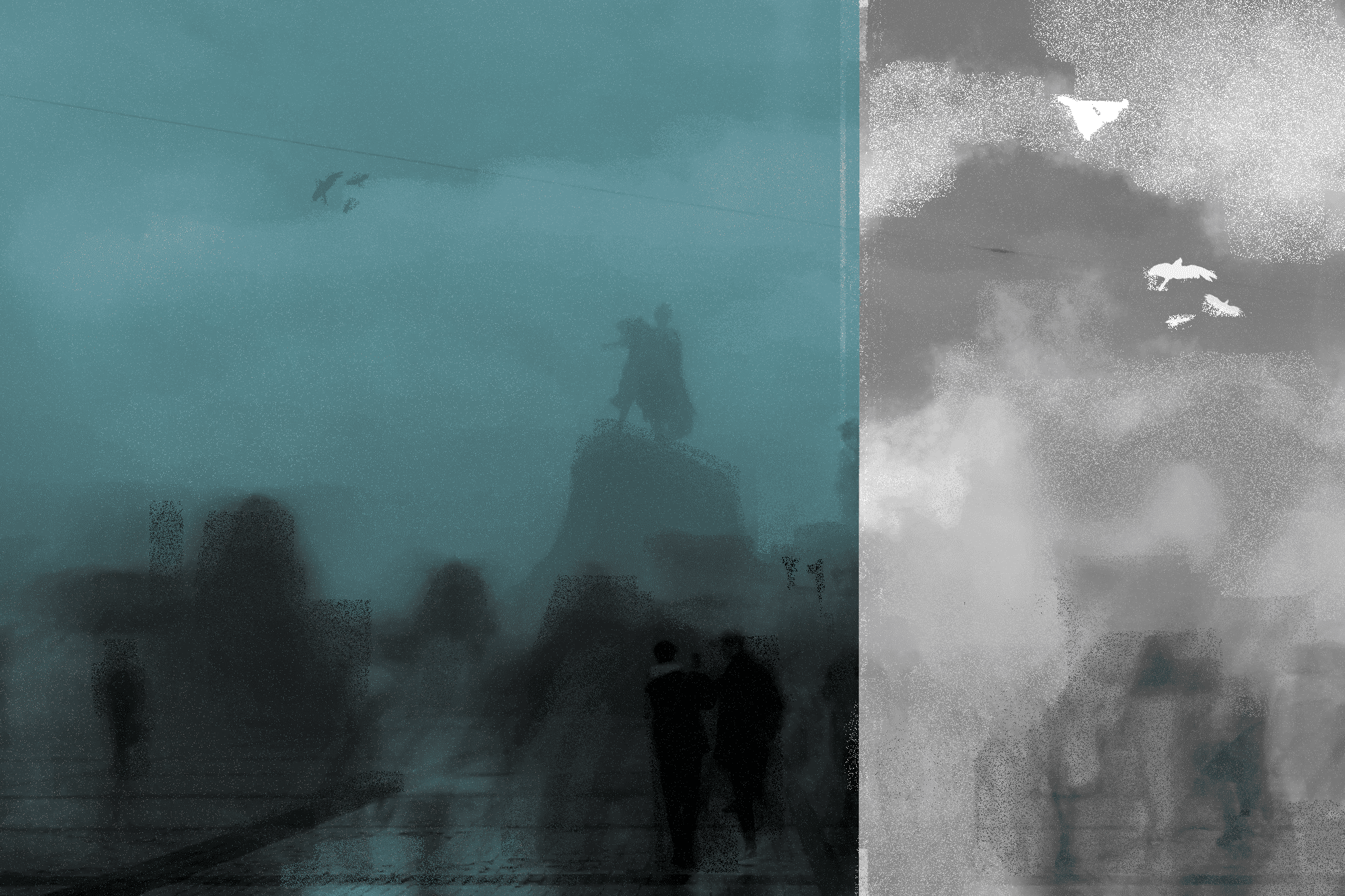
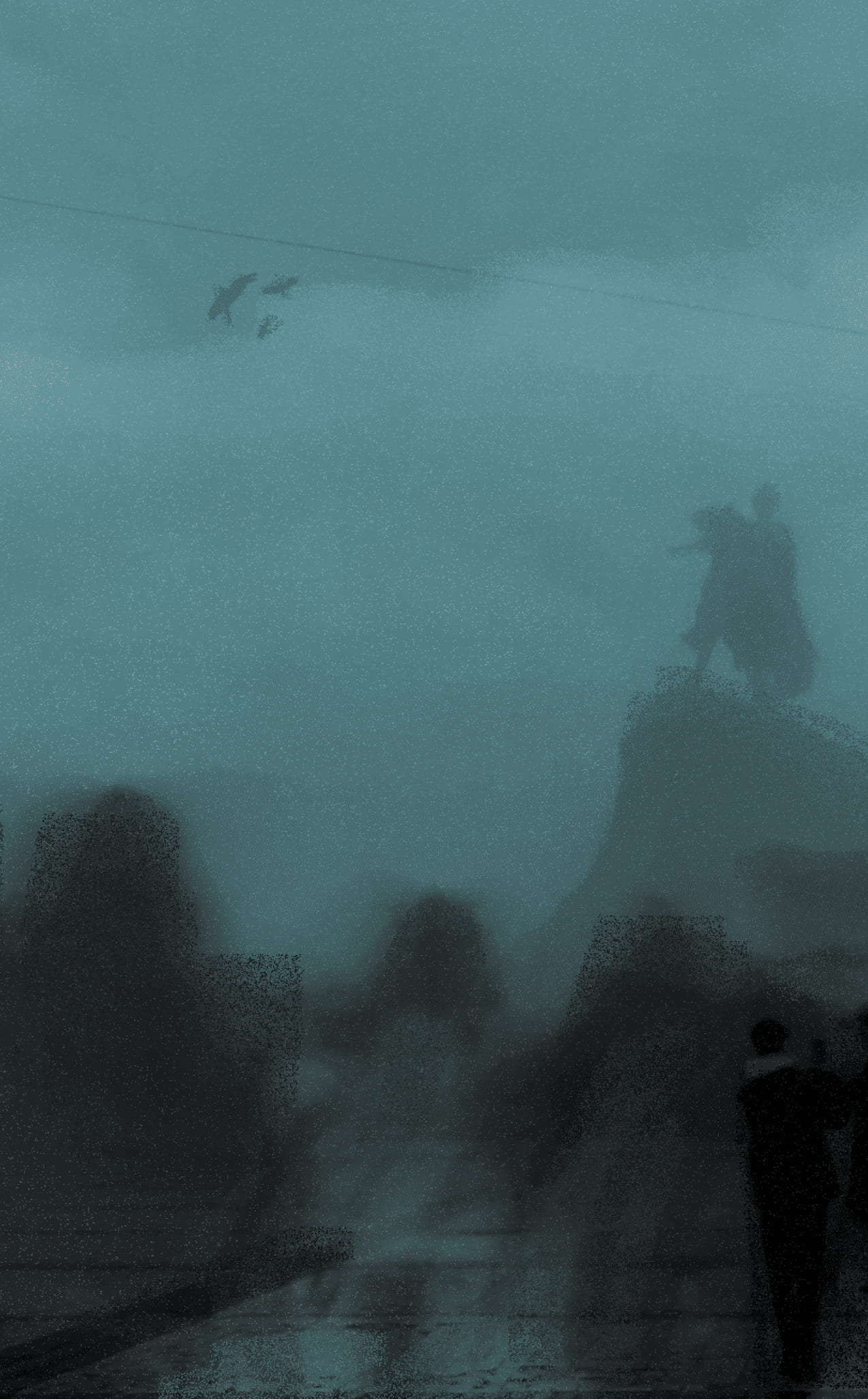
Illustration by Vadym Blonskyi
Translation from the Ukrainian by Liubov Kukharenko