Art Is His Tedious Routine
1.
Ihor Eduardovych thought long and hard about it, but still couldn’t decipher the meaning behind the odd exhibit with an inkblot painted on egg cartons.
“My God, what could this be?” He turns to his colleagues, inviting them to collectively solve the artist’s concept.
The men wearing overalls laugh flippantly, as if to say, “How silly.” Suddenly, a well-dressed foreigner appears. He introduces himself as the artist.
The men, who have been smiling just a moment ago, suddenly grow serious, looking sheepish.
“Those are spiders mating,” the artist explains.
2.
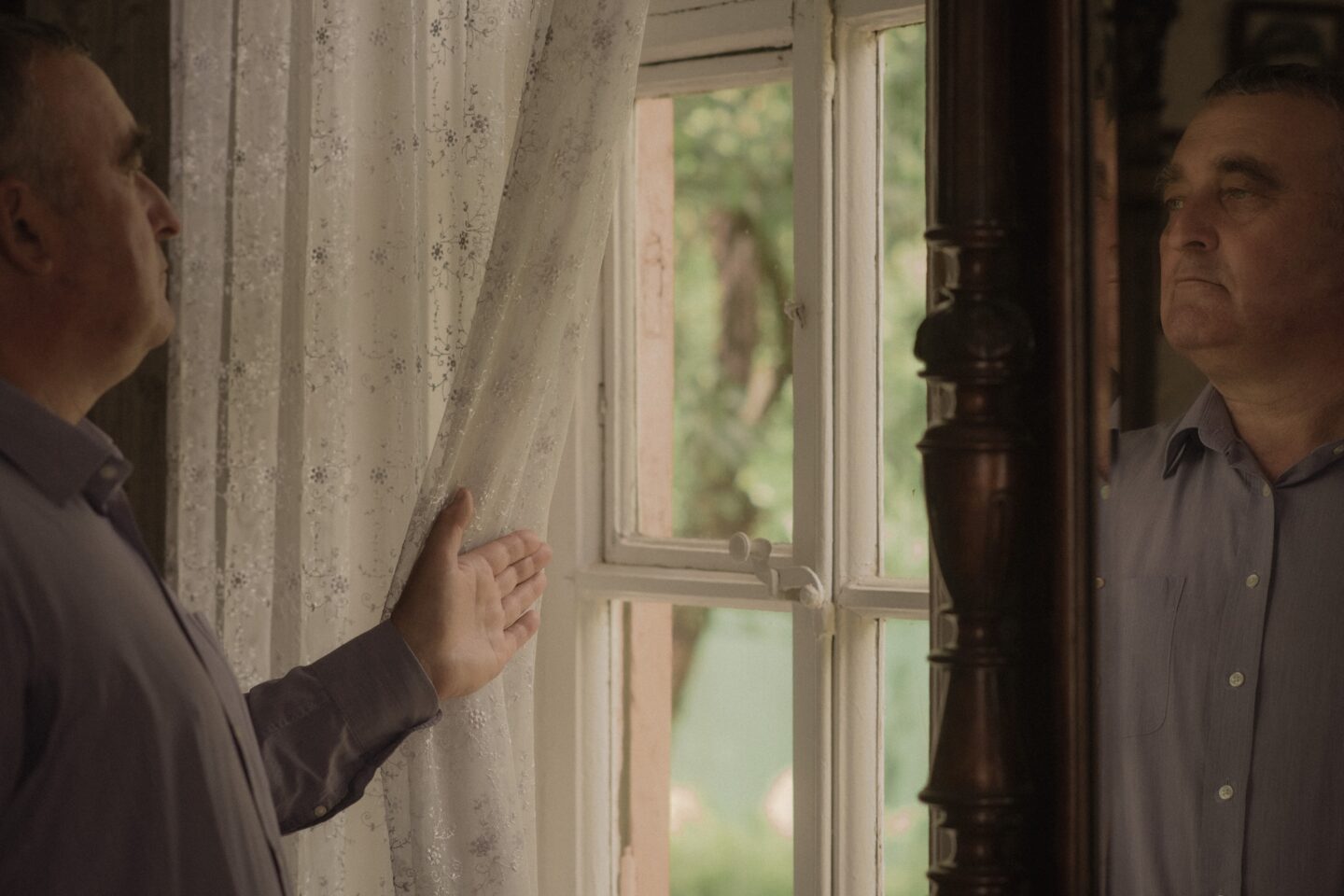
“The process of working with creative people is fascinating: they don’t see the world the way I do. Where I see simplicity, they see complexity. And vice versa,” says 60-year-old Ihor Eduardovych.
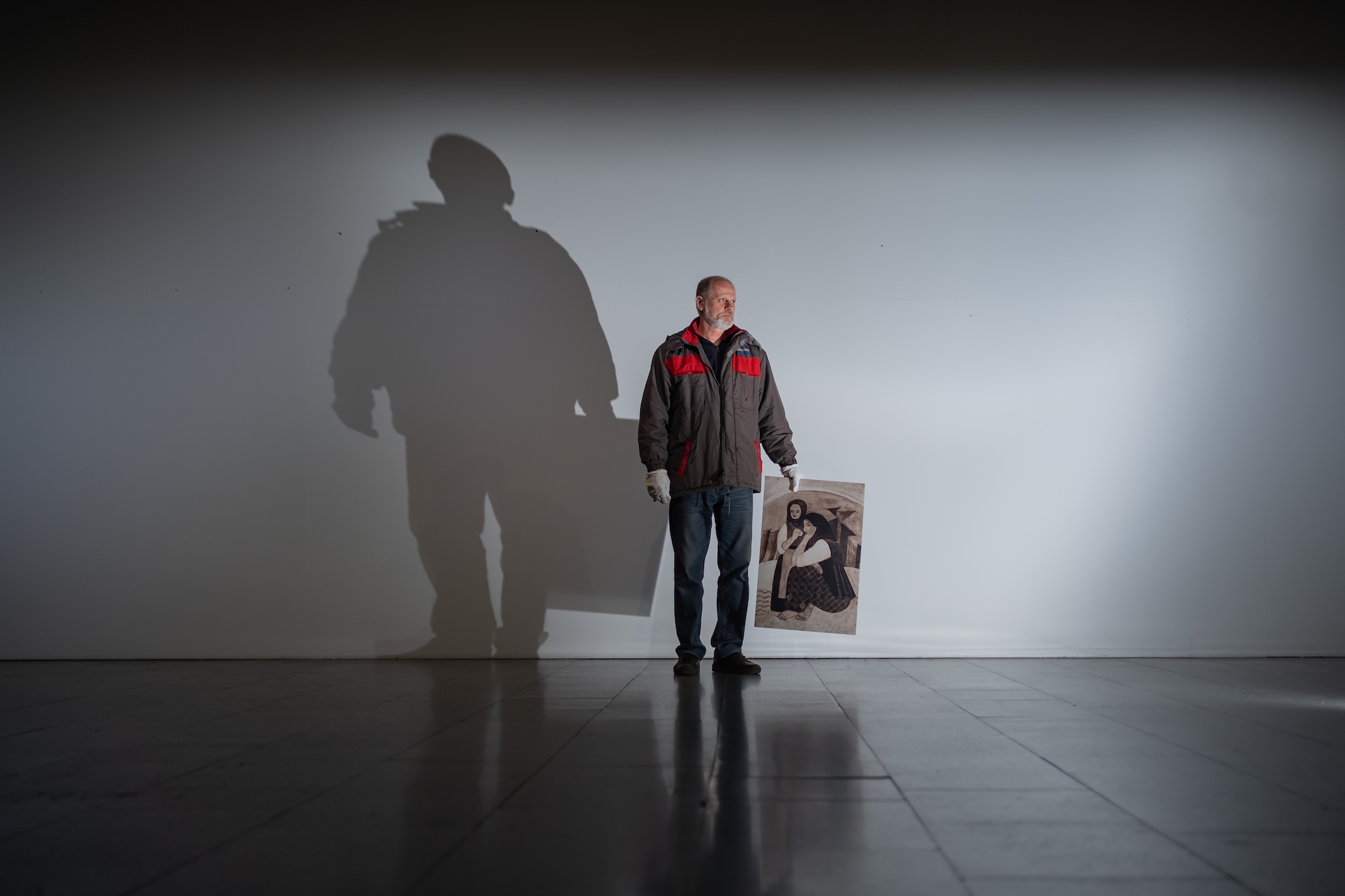
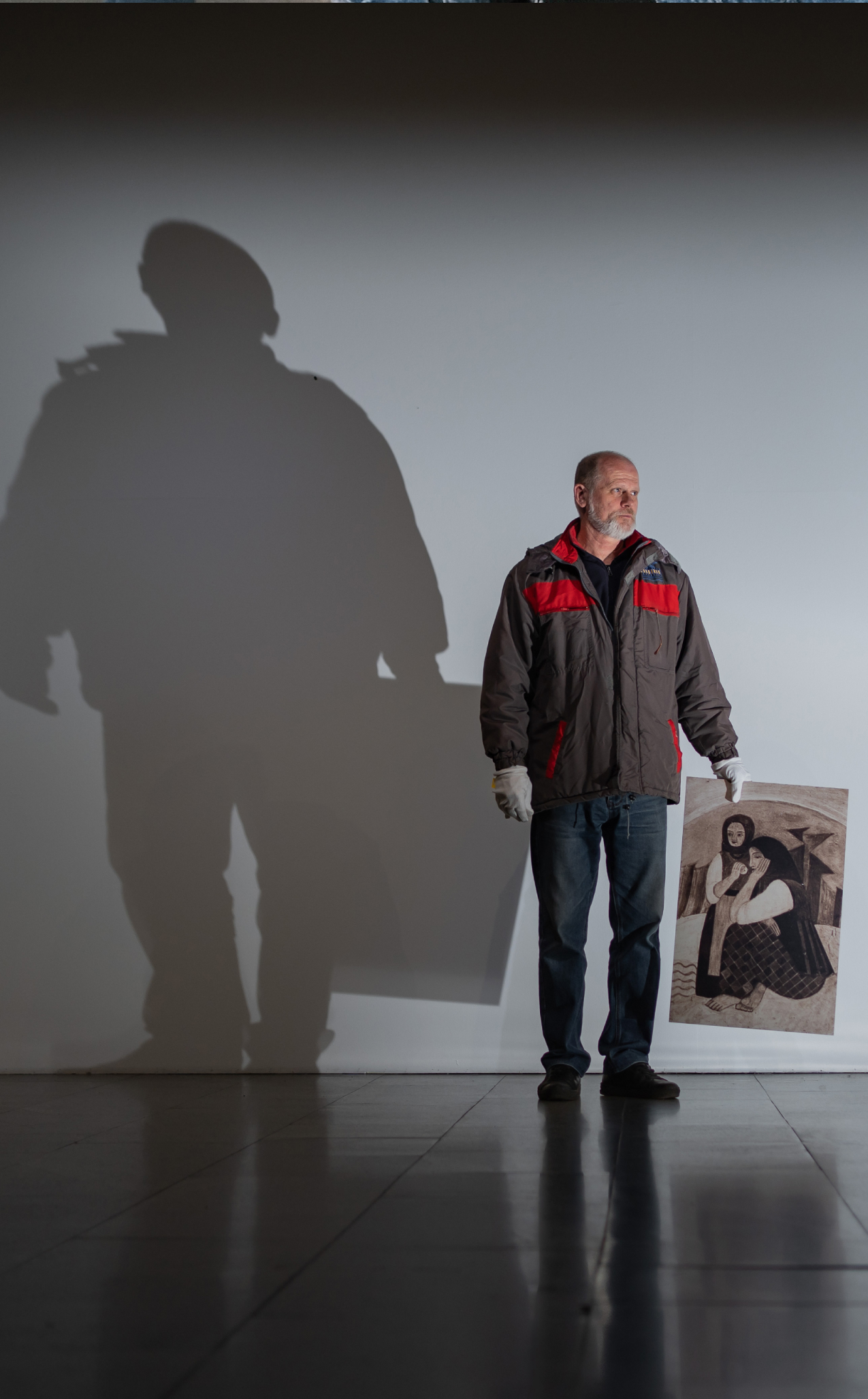
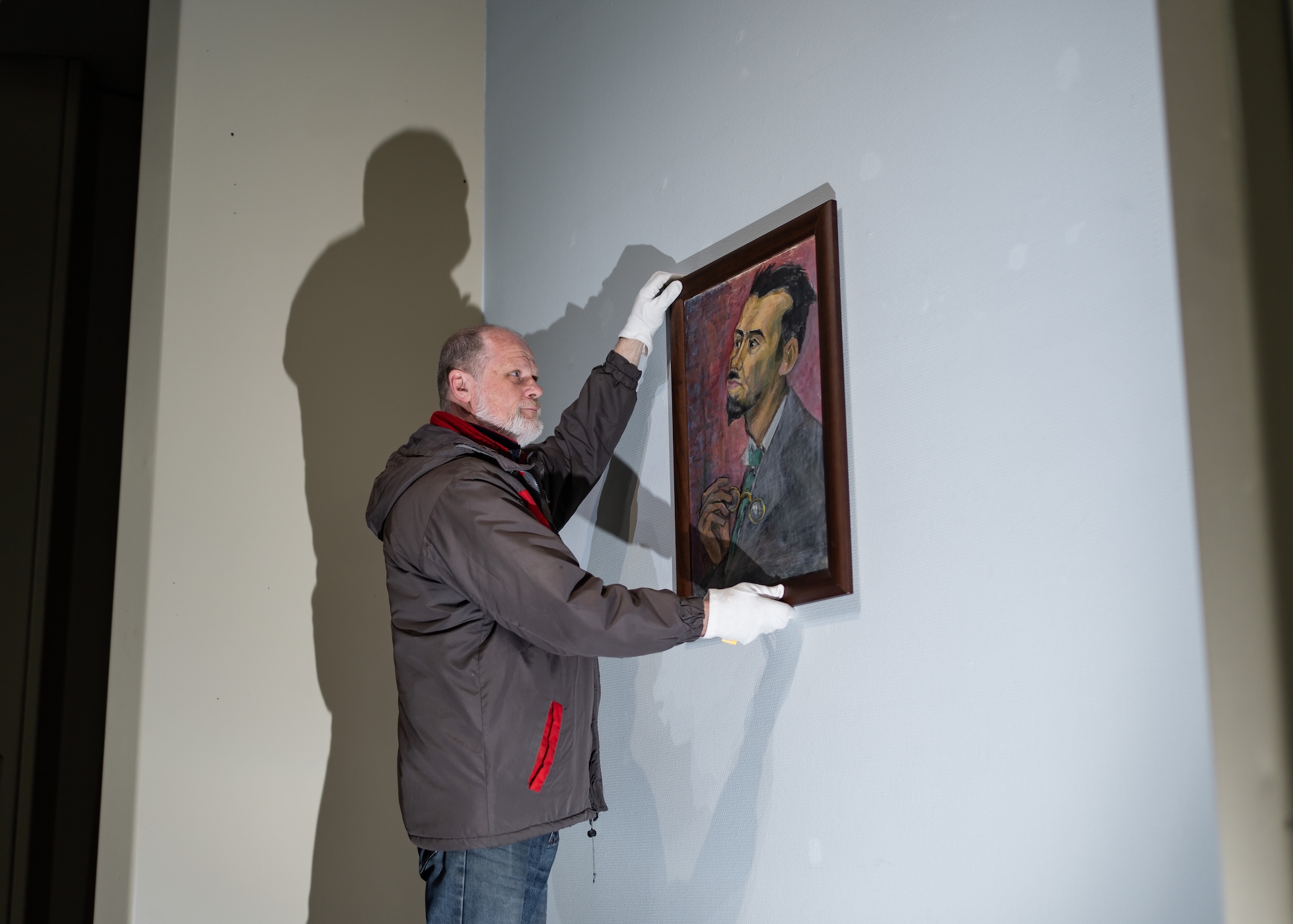
For the past nine years, he has been working as the head of the installation department at the Ukrainian House. His team of three unpacks paintings, hangs them throughout the exhibition space and builds small installations — they’re no mountain climbers or construction workers, but they come pretty close.
Their work process is chaotic and requires constant adjustments. The curators never approve the final layout of exhibits on the first try, so the installers have to redo their work several times.
At first, Ihor Eduardovych was irritated by these unfamiliar creative approaches. It took time for him to realize that “creativity cannot be linear.” He says that with complete acceptance.
Before he started working at the Ukrainian House, art had passed him by, just as he had passed by art. It wasn’t a love of beauty that brought him into the art world, but rather a factory going bankrupt, a store Ihor quit over corruption concerns, and a father who knew the right people at the Ukrainian House.
3.
Ihor Eduardovych spent 10 years working as a shift foreman at the Radykal factory, which manufactured foam rubber. In August 2000, the factory went bankrupt, and the former shift foreman decided to explore entrepreneurship. He opened a grocery store in Troieshchyna, hired employees and took charge of supplies and contracts.
“A grocery store is the kind of business that has to be under constant supervision. Otherwise, you’ll get robbed or go under,” he says.
He closed the store after 15 years in business. It didn’t go under; he just got tired of the red tape. The search for a new job dragged on; everywhere he applied, he was turned down because of his age — he was nearing 50 at the time. His father, who worked as a mechanic at the Ukrainian House, asked management if there was a job available for his son. That’s how the former foam factory shift foreman became a guardian of other people’s beauty.
Since then, art has become a tedious routine for him.
4.
“Ihor Eduardovych, come to the exhibition opening,” curators often invite him.
“You know, I’ve not only seen, but touched every painting from all sides,” he declines diplomatically.
The man held in his hands 18th-century icons, silver coins from the time of Yaroslav the Wise, sketches by Alla Horska, and rescued paintings by Maria Prymachenko.
There’s not a lot that can still surprise him — it would take something truly spectacular. Or something silly, like spiders mating.
“I can’t even describe the mish-mash all these artists have created in my brain”, he says.
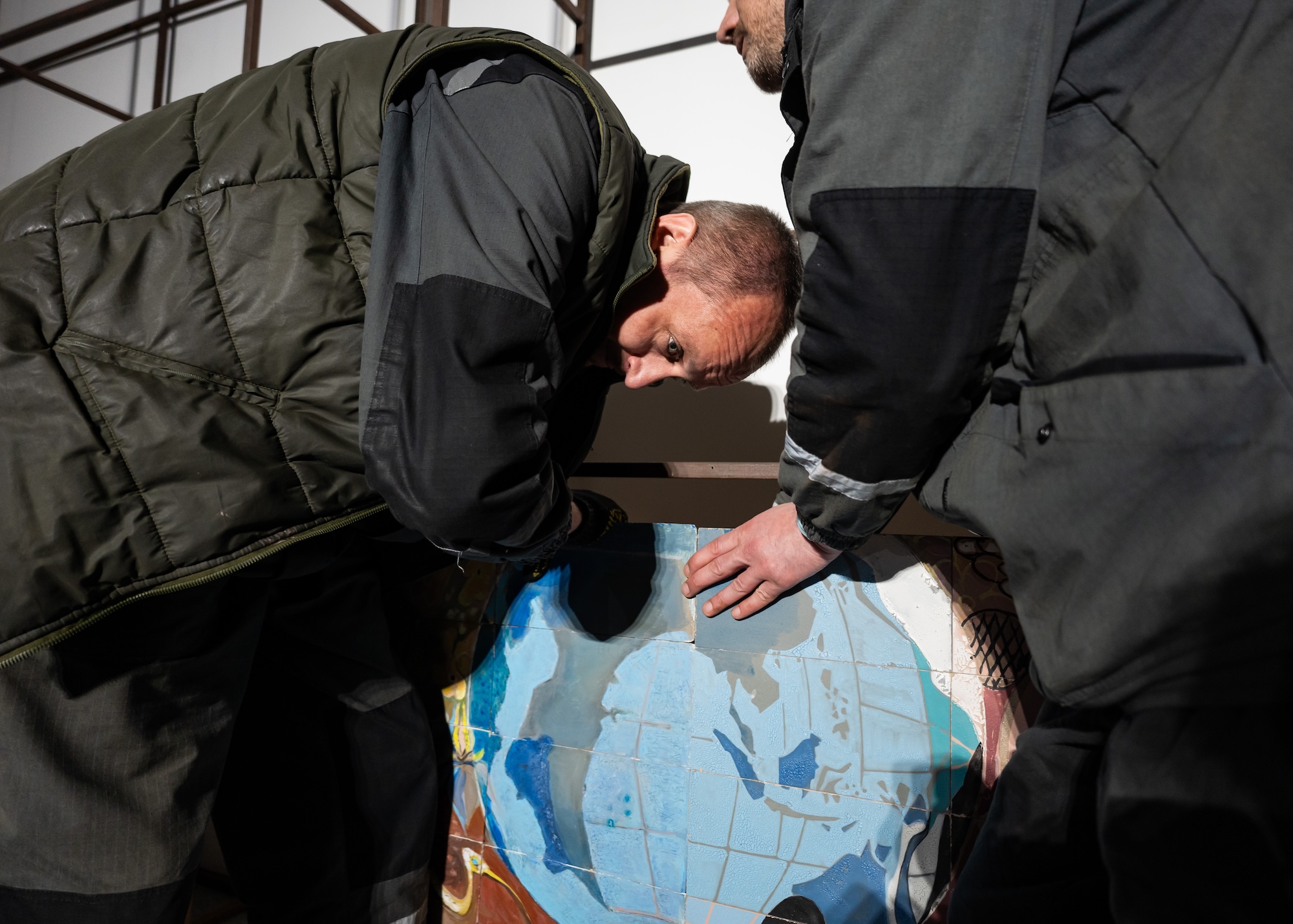
He’ll always remember the ceramic artist and architect Liudmyla Meshkova. Sometimes, he and his “eagles” pick up works from artists’ apartments and studios when they are unable to deliver them themselves. So, before the exhibition opening, the guys were sent to the home of the 87-year-old artist — and even if she had been younger, she would hardly have been able to carry her work from Instytutska Street down to Khreshchatyk. The panel measured approximately 4 by 6 meters.
The truck pulled up to the checkpoint — beyond that point, entry into the government quarter is restricted. In the apartment, riddled with debris from a recent strike, stood the ceramic panel “May Night,” split into pieces. The artwork was first displayed in the early 1990s. Ihor Eduardovych touched the work that no one had seen in 30 years, but at that moment, he wasn’t thinking about that — he was more concerned with how to get “May Night” into the truck and deliver it to the Ukrainian House intact.
Every artist’s studio that Ihor Eduardovych visited looked similar — chaos reigned everywhere. Sometimes the artists themselves didn’t know which painting was where. He even had to help one of them search for a part of a triptych.
“It should be here somewhere”, the artist kept repeating like a mantra.
“Creative people can’t maintain order”, the man says, then immediately corrects himself. “I mean, for them, order is disorder.”
He’s not affected by beauty — he carries it, mounts it and transports it.
5.
He eats lunch alone behind the closed door of his office. Sometimes he watches videos about construction while he eats, but more often than not, he eats in silence. After a whole day spent around people, he craves some peace and quiet. But even here, he can’t always find a place to hide.
“Eduardovych!” his colleague bangs on the door with a question.
Eduardovych responds with his signature composure. People from his crew are hardworking laborers, passionate and foul-mouthed. Not everyone manages to keep them in line, but they respect their boss’s word. Ihor Eduardovych does manual labor alongside everyone else, even though his job title allows him to sit back in a leather chair in his office.
“If I could, I’d work alone,” he says. “If I can do a job by myself, I don’t even call the guys in to work.”
His job doesn’t tolerate even the slightest deviation — the paintings must hang perfectly straight, as if drawn with a ruler.
For his most recent exhibition, he hung 90 works on a single wall with exactly three centimeters between each painting.
“Maestro”, his colleagues laughed.
Eduardovych didn’t answer — he was still looking at the wall. Not at the paintings, but at the gaps between them.
6.
Ihor Eduardovych brags about only one thing — a photo from a fishing trip where he’s holding a shiny silver carp. And even then, he doesn’t get too boastful: “They took the photo to make it look bigger than it is.”
“Would you like to hold 30,000 hryvnias?” He holds out a strange cylindrical bundle that doesn’t even look like money. “They’re shredded — that’s how the National Bank disposes of old banknotes. Something left over from the exhibition.”
On the workbench next to the grinding machine lies a much more valuable item — his grandson’s broken toy. Ihor Eduardovych suggested that the little boy throw it away and buy something new, but the four-year-old said firmly, “No, it’s mine.” Grandpa didn’t argue with the “client” and set about repairing it.
His sliding-door closet is filled with fasteners, frames and laser levels — everything is exactly where it should be. Throughout the day, he checks several times to make sure that’s still the case.
Physical work hardly tires him at all; he finds people far more exhausting. In addition to the roughly 60 employees at the Ukrainian House, there are also many visitors, contractors and other strangers who constantly pester him for something. The hubbub doesn’t let up even in the evening: as soon as he steps out of one hive of activity, he immediately finds himself in another — Khreshchatyk, one more drain on his energy.
“I’m tired of the flickering before my eyes,” says Ihor Eduardovych. “These days, everyone prefers some peace and quiet.”
7.
Ihor Eduardovych unsubscribed from all Telegram channels when he realized that this new phase of the war wouldn’t end as quickly as people were saying online. He even unsubscribed from the channels that informed about air-raid alerts — since then, his wife has become his personal source of information.
He takes the news hard and feels it to his core. He can’t help it — his son and son-in-law are in the Armed Forces. In another life, before the full-scale invasion, Eduardovych would escape the noise by the mouth of the Desna River: he’d cast his feeder into the water and watch the sensitive tip of his fishing rod. His thoughts would plunge deep into the river and get lost in the tangled algae at the bottom.
His main goal wasn’t to catch any fish. He doesn’t eat fish anyway. A chance to make mistakes without consequences, a few hours doing something trivial — that’s what he was really after.
8.
When he was little, Ihor — back then, without the “Eduardovych” add-on — stayed with his grandmother in the village of Bratslav in Vinnytsia Oblast. He had no money and wanted to go fishing. He didn’t dare ask his grandmother for a new fishing rod — she’d just send him home to read the books on his school reading list. So the boy collected glass bottles in the park and turned them in at the recycling center. One bottle was worth 12 kopecks. To buy a bamboo fishing rod for 2.5 rubles, he collected 21 bottles.
He quickly grew tired of catching small crucian carp from the shore. The boy wanted to row out to the middle of the river and catch real carp, catfish and pike. All boats were chained to the shore, so he found a tire, wrapped a rope around it and placed a plank on top. His grandmother, unsure of her grandson’s engineering skills, tied another rope to the boat and held it from the shore while her little engineer dangled his feet in the water, hoping to catch a carp in the shallows of the Southern Buh.
After his grandmother died, the boy stopped visiting the village, but fishing followed him into adulthood as the only activity where he alone could decide what mattered and what didn’t.
9.
“My colleagues once told me that I’d been smiling less,” says Ihor Eduardovych, who no longer bears resemblance to the little boy he used to be.
He’s also been spending less time in silence. Perhaps the two things are related. Since February 24, 2022, people have started aging faster.
At the start of the full-scale invasion, Ihor Eduardovych and his wife found themselves at their summer house with his elderly parents in the gray zone near Borodianka. For two weeks, mortars and howitzers fired from both sides, helicopters clattered, planes whistled, tractors roared, and sirens wailed. Only the forest, dusted with light snow, remained silent, as if indifferent to it all.
Ihor Eduardovych tried to persuade his parents to leave, but they had no intention of abandoning the cottage — who would tend the garden, with spring just around the corner? “Go, children,” his parents said. When all essential utilities were cut off, the children finally left.
All main roads were blocked, so their small convoy of four cars drove across the forest, maneuvering around fallen logs. At some point, a man darted from a house that appeared out of nowhere and pointed the way.
In the first village on the road to Kyiv, houses were on fire, and no one was in a hurry to put them out. “Please, don’t stop,” his wife pleaded. There was a checkpoint at the exit.
“Where are you headed?” the soldier asked.
“As far from the Russians as possible,” Ihor Eduardovych replied.
They didn’t stop until they’d crossed the second line of defense and found themselves on the Zhytomyr Highway. The man went into a store and bought a stick of sausage and some bread, which he hadn’t seen in two weeks.
“I never knew you could crave bread that much,” he says.
10.
In April, management issued an order to return to work within the marble walls of the Ukrainian House. Now it’s much harder to escape the hubbub than before the war — his favorite fishing spots have been taken over by the military, news seeps through to him unavoidably, and silence has become a luxury one must seek out.
Recently, he took his grandson to the North Bridge. While the boy played in the sand, Ihor Eduardovych cast his line and watched the tip of his rod. An hour passed — he hadn’t caught anything.
“The water’s still cold,” the man said.
His grandson didn’t ask about the fish. His grandfather didn’t explain why they were there. They just sat there, inside the moment between casting the line and a fish biting, within the lull where nothing happens. Ihor Eduardovych knows this feeling well. He’s been searching for it his whole life. Where others see nothing, he’s long since learned to see what matters.
Translated from Ukrainian by Liubov Kukharenko