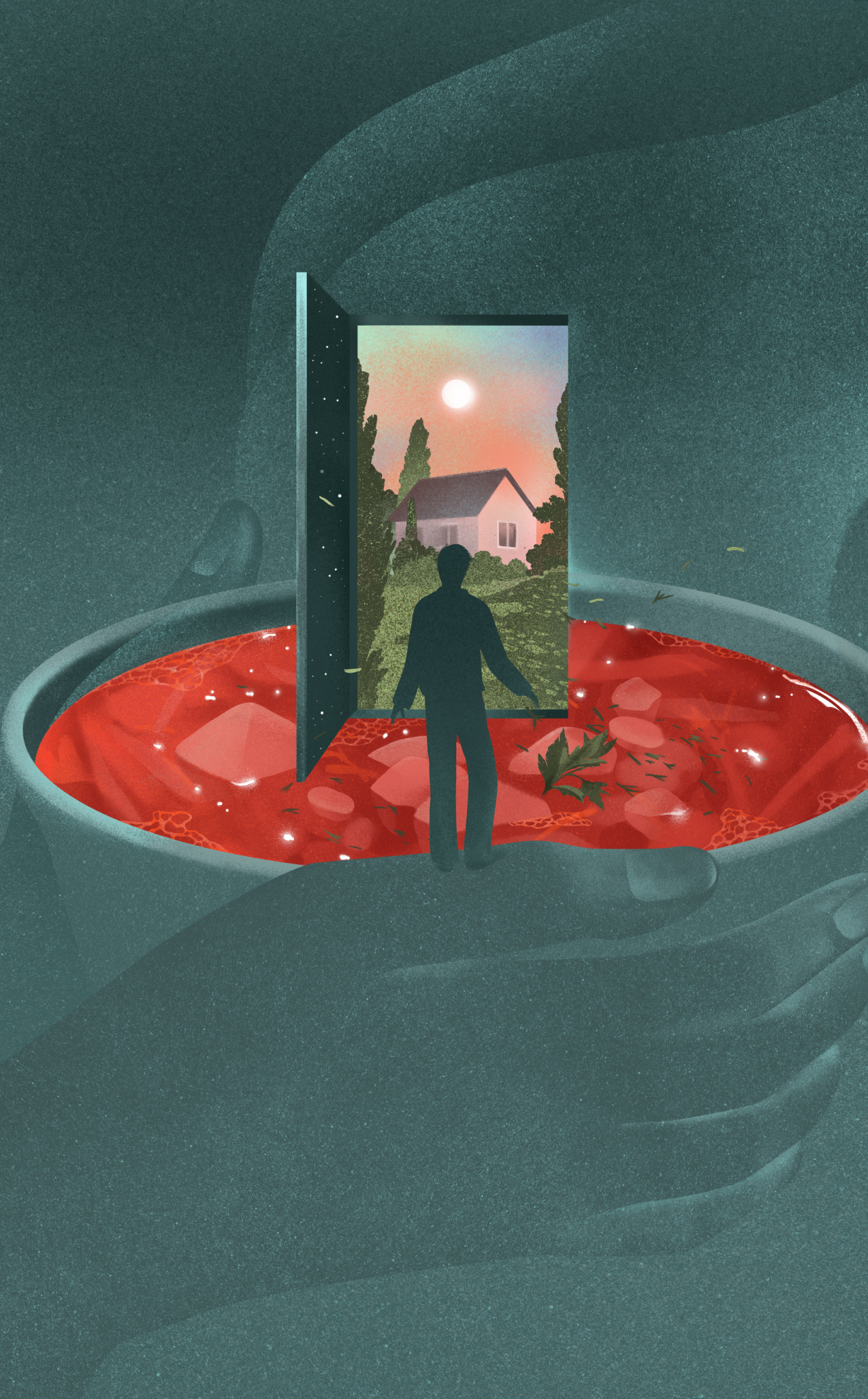
A Fairy Tale About Hunger

Їсти, любити, воювати
Цей текст опублікований у друкованому журналі Reporters
In the photo, a man in a military uniform is holding an apple, his left hand cupping his right to keep from dropping it. He is sobbing; the still image conveys the trembling of his hands. The camera captures the man from below, over a blue package — the kind with which Ukraine welcomes prisoners of war returning home from Russian captivity, a blindingly golden-red apple emerging from it. The camera focuses on the man’s emaciated face. It appears almost ageless, his childlike despair layered over lines etched by torture.
This photo recalls another image of a serviceman brought home after ten months in captivity. In it, the restaurant owner-turned-soldier gazes at an apple with unspoken wonder. He hasn’t seen fruit in a very long time. The clothes he wears hang off him like a parachute — during captivity, he lost 30 kilos.
In Abrahamic traditions, tasting the fruit from the Tree of Knowledge symbolizes a rite of passage, from heaven to earth and its suffering. However, for Ukrainian prisoners of war, this transition seems to happen in reverse: they are not being expelled from paradise, but brought back to life from the very depths of hell. A profound understanding of both good and evil is carved into their faces.
The intertwining of the concepts of evil and hunger in the Ukrainian national tradition is not unique. All over the world, folk tales are filled with fantasies about plentiful food — a house made of gingerbread, a cauldron infinitely bubbling with sweet porridge, a table that sets itself with a plethora of dishes. However, the most terrifying Ukrainian fairy tales about hunger emerged not during medieval food shortages, but in the 20th century.
In the 1930s, Ukrainian artist Maria Prymachenko, from the Polissia region, painted mythical beasts with bulging eyes devouring inedible seeds and flowers; she painted predators staring at the viewer, their hungry maws gaping, their bodies convulsively twisting to feed one another. Prymachenko wrote on one of her paintings: “And the beast walks on and dozes, searching for food; when one is hungry, one has no mind for fanciful clothes — when one wants to eat, one wants nothing else.”
The motif of hunger may seem odd for a people who inhabit the continent’s most fertile lands and cultivate the very wheat fields that fueled the colonial ambitions of 20th-century dictators. Indeed, Lenin desperately sought to feed the revolutionary proletariat with Ukrainian grain. In 1918, at the height of the civil war raging in the wake of the Bolshevik Revolution, the bearded troll wrote in his fervent telegrams from Moscow to the Ukrainian front: “For God’s sake, take the most energetic and revolutionary measures to send bread, bread and bread!!! Otherwise, St. Petersburg will starve to death.”
By the late 1930s, the leader of the Third Reich was already promoting the idea that Ukrainian grain was a guarantee that “no one would be able to starve out” the Germans, as had happened in the previous war. However, to achieve this result, 30 million locals had to “die out,” according to the Nazi Hunger Plan. The Nazis did not have time to carry it out during the occupation of Ukraine in the 1940s, but a few years before that, the Soviet authorities had successfully implemented an attempt to subdue the Ukrainian peasantry through starvation. According to the most conservative estimates, at least 3.9 million Ukrainians died as a result of the Holodomor of 1932–33, designed by the Kremlin
The ones who survived were the ones who practiced witchcraft.
The best cooks were true witches — they mastered the art of transfiguration. Armed with a mortar, a pestle and a survival instinct, they turned dry clover leaves mixed with flaxseed and hot water into bread. They made pancakes from tree bark, soups from grass and the roots of reeds. They turned potato peels into a life-giving elixir. Thanks to spells, brews and a good dose of luck, they overcame the inevitable death by starvation — some of them.
The current generation of Ukrainians has experienced the bitter echoes of those rituals: sweeping crumbs off the table and quickly eating them; force-feeding grandchildren until they turn pale with nausea. Hiding cookies under the mattress, crackers under the pillow, dried apples between the bedspreads and keeping track of where the food is hidden long after old age has eroded common sense, memory and consciousness.
Ukrainian grandmothers guarded their secrets and practiced magic clandestinely, in silence. The terror of the 20th century robbed many of their language and voice.
Their grandchildren had to scour declassified archives and diaspora publications to fill in the gaps in their family histories gnawed out by terror.
Since the Holodomor, Ukrainians no longer see food merely as sustenance. When the Russians burn black soil fields, bomb grain silos and starve prisoners of war, they are deliberately summoning the ghosts of that catastrophe.
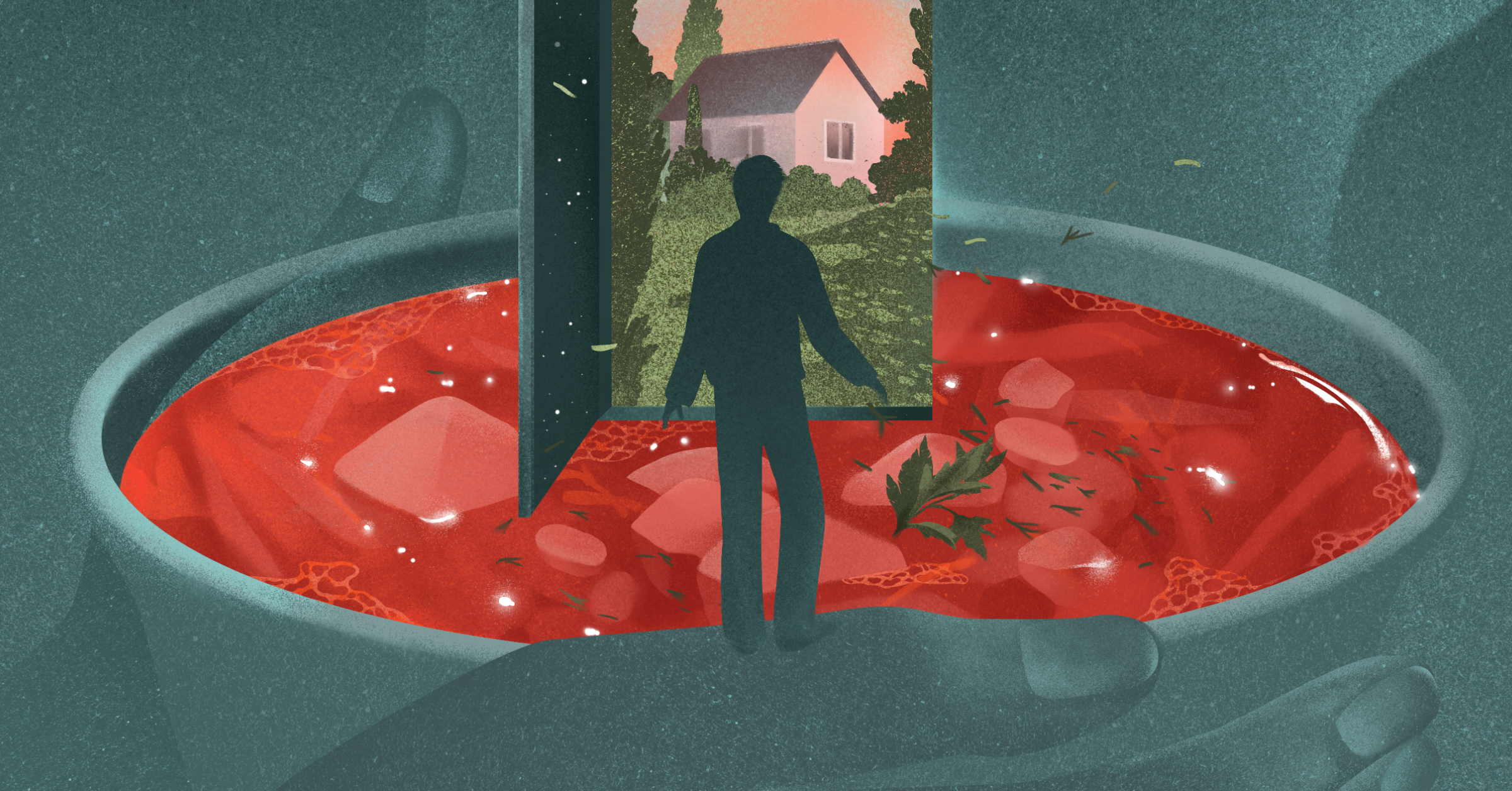
Another man, whose story was recorded by his wife, weighed only 50 kilograms after a year in captivity. He would wake in the middle of the night and go straight to the kitchen, standing before the open refrigerator as if spellbound, staring at the food. He needed to hold the pot of borscht in his hands, to breathe in the scent of the pie. His wife would not let him eat. In the first weeks of freedom, prisoners released from this modern-day Gulag must, despite constant hunger, eat only in small portions and under medical supervision.
In the center of Kyiv, the sisters, mothers, wives and daughters of prisoners of war gather in the kitchen of an underground restaurant. The loved ones of these women have not returned home yet; perhaps they never will. Still, the women come together and prepare a meal for strangers who have endured months of torture and weep at the sight of apples. The women cook dishes from a cookbook whose author was killed by a Russian missile strike. It is a subterranean sisterhood of witches, gathering to feed the living and honor the dead.
*
Originally from the village of Uspenka in central Ukraine, the author of that cookbook chose the name Kolyorovo. She was a cheerful witch with green hair who worked her magic in the realm of flavors and imagery. Kolyorovo taught young people to express themselves through drawing and break the cycle of inherited silence. She also taught children to cook, seeing it as another art form.
As Olena Styazhkina explains in her book “Taste of the Soviet Union,” food reflects our fundamental trust in the world. Soviet citizens had little chance to build that trust.
The USSR turned food into an instrument of punishment; the Holodomor was the most radical example of this punitive project.
By the late Soviet period, food had already been transformed into fuel, intended to infuse the worker’s body with calories, not with sensory experiences or cultural memories. Waiting in line for a meager selection of food became its own form of labor and punishment, often with no guarantee of success. The standardized, joyless Soviet ration — with its “Olivier” salad on New Year’s and a gray, shapeless mass of macaroni every day — deprived people of two essential things: choice and identity.
Olya Kolyorovo’s “Living Ukrainian Cuisine” — vibrant, vivid and sensually inspired — brings us back to these essential aspects of food culture, shattering stereotypes about Ukrainian culinary traditions. If it’s borscht, then it’s Kupala-style from Sumy with ceremonial dumplings and crayfish, or Western Ukrainian Christmas borscht with herring-stuffed pie. There is lard soaked in beet kvass and varenyky made with choux pastry. Carp in spiced honey; Uspenka-style cabbage soup; chard topped with millet; beans in sour cream, shulyky pastries with poppy seeds, honey and dandelion roe, rolled porridge with chanterelles; beetroot and potaptsi grilled bread: “Living Ukrainian Cuisine” evokes the banquets described by Kotliarevsky, whom Kolyorovo quotes generously. The revival of forgotten Ukrainian dishes goes hand in hand with a renewed zeal for history, personal agency and freedom.
Kolyorovo spoke with elders and recorded the stories behind forgotten dishes. Through them, the country’s buried histories were unearthed. In Bessarabia — amid an ethnic mix of Ukrainians, Bulgarians, Romanians and Gagauz — she came across an edible bauble she had known since childhood in Uspenka: Christmas cookies coated in beet juice and decorated with frost-patterned blue icing that cooled the mouth with a minty aftertaste. Following this trail of cookie crumbs, she uncovered a story of forced displacement.
In 1826, when the tsarist gendarmerie announced the establishment of a military settlement in Uspenka, the residents of this ancient Cossack village rose up in revolt. As punishment, just as December frost set in, their windows were smashed and their stoves destroyed. Some of the residents of Uspenka fled south, where they founded the village of Plakhtiivka in Bessarabia, adopting the original name of Uspenka and carrying on the tradition of making these Christmas treats for another 200 years.
A Christmas “lady,” a doll with a cross on its face reminiscent of both traditional motanka dolls and the geometricized peasant women of Boychukists and Malevych, adorns the cover of the book. The red leather binding, which resembles a Poltava plakhta, holds recipes and stories of regional dishes alongside the author’s photographs, as well as more than a hundred watercolor illustrations, plus stickers, postcards, bookmarks and envelopes. These unexpected treasures created by Olha seem to reveal new culinary horizons to discover and joyfully share. This culinary encyclopedia arose out of that special period when joy and openness returned to Ukrainian gastronomic history. It was completed in 2022.
Before the full-scale invasion, Kolyorovo won a U.S. green card and was planning to explore a new continent. Her journey was supposed to begin on the very day Russian bombs started raining down on Ukrainian cities. Kolyorovo reached safety with her daughter; they walked 20 kilometers to the Polish border. In the summer of 2022, Olya returned to Ukraine with two suitcases of donated goods.
Kolyorovo was the embodiment of life itself. Yet her life was cut short by a Russian missile fired at a shopping mall in Kremenchuk in June 2022.
*
A person who’s been starved, who cries at the sight of an apple, who has lost nearly 40 kilograms, who wakes up in the middle of the night just to hold a loaf of bread in their hands and look at the borscht in the fridge — what would they want most of all? Comforting food that tastes sweet and warm, smells like home and promises that from now on, there will be plenty of everything, forever.
“The kind of dish you can serve every day or on holidays — yet so delicious you would not be ashamed to offer it even to the gods of Olympus,” Kolyorovo writes of the “small, fluffy buns” known as Poltava pundyks, citing a reference to them from the margins of Kotliarevsky’s “Eneida.” Ukrainians undergoing rehabilitation in military hospitals after captivity in Russian prisons are treated to Poltava pundyks drizzled with honey from Kolyorovo’s parents’ apiary.
“You have it worse than we do,” say the exhausted men, who were being tortured just a few weeks ago, to the women who are still waiting for their loved ones to return from captivity. They dip their pundyks in honey from Uspenka. The women embrace these strangers-turned-family. In the space between them, the strength to carry on brews quietly.
There are pastries that can make you grow or shrink; apples that can put you to sleep in a glass coffin; pumpkins that can carry you to a royal ball. And there are confections that can restore the taste of life, and Kolyorovo knew their recipes. Her legacy lives on in the pages of a book bound in the red of a traditional Poltava skirt.
A part of this text, dedicated to the memory of Olha “Kolyorovo” Pavlenko, was published as part of a special project by PEN Ukraine and The Ukrainians Media, “People of Culture Taken Away by the War.”
Translated from the Ukrainian by Liubov Kukharenko
Ознайомитись з виданням
Доступно Спільноті
Їсти, любити, воювати
Відкрийте для себе історії з цього номера
Переглянути число