Our Friend in Captivity Is a Living Audiobook
1.
The ring road on the outskirts of a border town. Buses travel along the highway, winding through tall pine trees. There are too many to count. They stop, and pale, short-haired people in faded blue prison clothes get off. They lie down on their backs on the emerald grass and weep. This is an exchange of “all for all,” I realize. But instead of greeting our people, jumping for joy and offering my phone so that one of them could finally call home, I, too, lay down on this incredibly green grass. I can’t help it, the tears just keep coming. Suddenly, I wake up. It’s just a dream, my pillow is soaked with tears. Thousands of Ukrainian soldiers and civilians remain in captivity.
2.
My colleagues and I find out about the date of the exchange beforehand. In the morning, we pile into the car and drive out to the meeting point. For the past year and a half, the exchanges have taken place in Chernihiv Oblast. There’s a gas station along the way where we stop for coffee. We usually have a wait time of three to seven hours. We sip our coffee and say what we usually say:
“Our guys must already be there.”
“They’re somewhere near the Belarusian border.”
“They’re probably untying their hands right now.”
“Maybe they’ve already taken the blindfolds off.”
“They should realize by now that this isn’t a transfer, but an exchange.”
“Our people will be here soon.”
We talk about it as if it were perfectly normal, although the procedure we’re describing is more akin to a medieval barter — some humans (our people) are being exchanged for others (the occupiers, but technically still humans).
An hour and a half before reaching Chernihiv, the buses carrying our people should already be crossing the border from the Belarusian side. There, they check the names, do the count and usher everyone into the bus. The doors close, and, as the bus approaches the border, a representative of the Coordination Headquarters for the Treatment of Prisoners of War says loudly:
“Welcome to territory controlled by Ukraine.”
3.
In Chernihiv, people are already gathering at the meeting spot. Most of them are holding photographs. These are relatives of prisoners of war who hope to receive new information about their loved ones. They are also relatives of those missing in action who long to find at least a glimmer of hope: perhaps someone happened to see their loved one and can confirm that he is alive. In captivity, but alive.
Most of them already know each other. Like us, they never miss a single exchange. Everyone has a portrait in their hands; sometimes it’s a whole collage. If someone else’s relative couldn’t make it or is unable to come, others hold up a photo not only of their own son or husband, but also of a missing comrade.
The portrait includes the person’s last name, first name, call sign, age, the area where he fought, his brigade or battalion, his family’s contact information, and where he went missing. Sometimes there are several photos of the same person, with and without a beard.
This search method yields almost no results. But there’s a box at every entrance where people put stacks of photos, which will later be sent to rehabilitation centers along with the released detainees. Once they’ve caught their breath and rested, the released prisoners will have a chance to look at the photos more closely. Although the kaleidoscope of hundreds of photos at the entrance lasts less than a minute — and it’s practically impossible to recognize anyone while rushing off the bus — relatives still cling to this even slim chance.
We already know many of them. Sometimes people ask to take photos together. With one woman, we started joking: “Sure, let’s take a photo, but don’t forget to give a proper holler when the notification comes.” She promised to shout as loud as she could.
Everyone here is waiting for the notification. If a loved one has been exchanged, as soon as the buses carrying the released prisoners cross the border, a notification appears in the Diia app: “Congratulations! Your husband (or son, or father), First Name/Last Name, has been released from captivity.” Then comes the text message. They might even call.
We take a photo with a woman and wish her “to receive the notification.” On the day of the exchange, this wish is more important than any other.
In less than 10 minutes, we hear her scream. The woman screams at the top of her lungs. Her son is returning from captivity.
Happiness can be deafening. So many times, family members have fainted from the sheer intensity of their emotions.
Wives and girlfriends worry — they didn’t get their hair done, didn’t have time for a manicure, didn’t put on their best dress. In less than half an hour, he’ll call and see her: she needs to put on lipstick right away.
4.
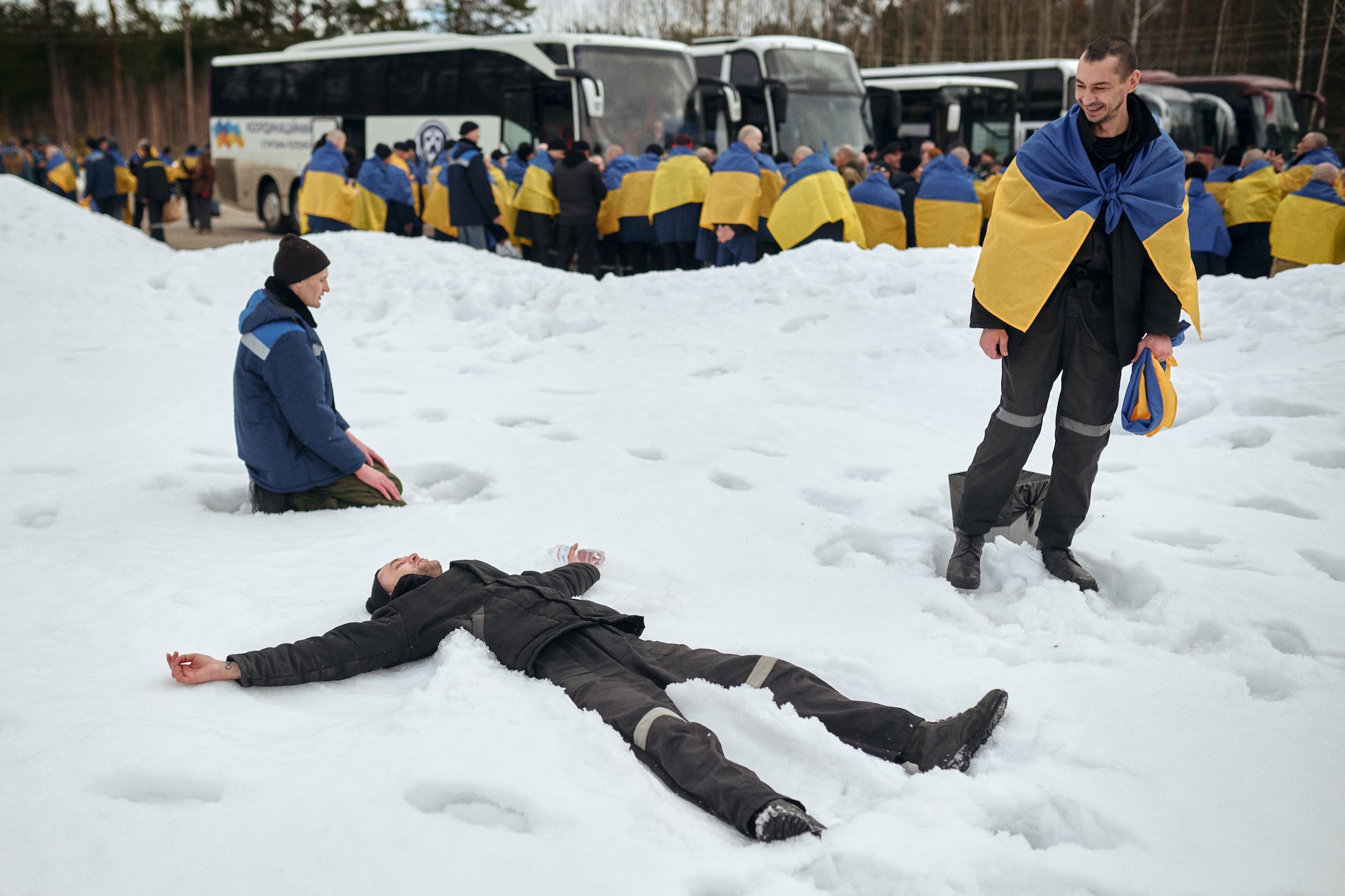
An hour’s drive from the border is a clearing where the newly released prisoners step off the buses for the first time. They are given blue-and-yellow flags and their brigade flags — it’s one of the first things they receive upon returning to freedom. They kiss the flag, often on their knees or raise it as high as possible and tie it around their shoulders.
Here, for the first time in a long while, they can stand without keeping their hands behind their backs or bowing their heads, except perhaps to admire the familiar ground beneath their feet. Amazingly, they can look up at the sky, shout at the top of their lungs whatever they want, hug their comrades, get a whole pack of cigarettes and know for sure that they don’t need to ration them.
From the videos that first appear on social media, one might draw the false conclusion that everyone is feeling just one emotion — absolute happiness. In reality, many of those who have just been released are at a loss. Some are fidgeting and can’t stand still because of their excitement, while others are disoriented by the abundance of light, fresh air and people.
Then they make their calls home, and there are so many things they’re afraid to hear:
“Is Mom alive?”
“Is our house still standing?”
“Did Grandpa and Grandma escape the occupation?”
“How’s my brother?”
“Tell me honestly — which of our comrades have died?”
I’m standing in this crowd and hear a good dozen affectionate variations of the word “mom”:
“Mama, I’m home.”
“Mom! Mom! Mom!”
“Ma, I’m back!”
“Mommy, everything’s fine, don’t worry, I’m alive.”
“…Dearest mother of mine, tell me why you aren’t sleeping…” [Excerpt of the song “Ridna Maty Moya” (“Dearest Mother of Mine” — eng. ), written in 1959 by poet Andriy Malyshko, centers on a mother’s devotion and the symbolic blessing of a rushnyk (embroidered towel) gifted for her child’s journey in life — Ed.]
The last line came from a young man wrapped in a Marine Corps flag singing to his mother over the phone. He doesn’t finish the song. Upon singing the last words, he covers his face with the flag and whispers, “Please forgive me.”
At this moment, many people feel guilty for what their loved ones have had to go through. They waited for months just to finally be able to ask for forgiveness.
In Chernihiv, at this very moment, relatives are receiving the calls. One of the mothers can’t hear what her son is saying to her and just keeps repeating:
“Dima, Dima, my darling, my son, I can’t hear you, my flower, my dearest, my little bird, everything’s fine, we’re all right here, we’re all here, Dima, we’re waiting for you at home, my sunshine, my boy.”
5.
One time, the exchange fell on my birthday. I allowed myself to dream that a miracle would happen, that my friend Sasha Ivanov, a Marine from the 36th Brigade, would return. The last time he called was from the Illich Plant in Mariupol. It was around four in the morning; the wounded were moaning in a dark bunker. He called via video link, and it was clear: he was about to be taken prisoner.
Four years have passed since then, but the miracle still hasn’t happened. So I just rejoice for others.
Viktoria is shouting about her brother’s return so loudly that she can be heard on several neighboring streets.
“Sashaaaaa! Sashaaaaa! Threeeeee years! Threeeeee years!”
She hugs his girlfriend, Nastia, whom her brother started dating when they were still teenagers. The girls are shouting, laughing and recounting how, on their way here, a wedding procession crossed their path; they were sure it was a good omen, and it indeed was.
The families of captives and the missing look for good omens everywhere. They don’t see the bad ones — only the good ones.
In a few hours, their Sasha, whom Nastia calls “my smiley guy,” will step off the bus and ask her to be his wife. And she’ll say yes. You should have seen that smile in response to her “yes.” Sasha really is her smiley guy.
Svitlana approaches the women to congratulate them. She didn’t receive the notification on her phone.
She hugs the girls — this is also a community superstition: to hug the relatives of those released, “to pass on the good luck.”
6.
Valentyna is holding a green fishing rod meant for her dad. She steps aside — her mom is calling. A minute later, we hear her joyful exclamation. Valentyna waves the fishing rod around:
“I told Mom: ‘If we take the fishing rod, he’ll come back!’ The guys who were released — the officers — said that my dad dreams of coming back, buying a car and a fishing rod, and going fishing. I told Mom, ‘If we take the fishing rod, they’ll exchange Dad.’ But Mom didn’t believe me.”
Her dad, Yevhen Anatoliyovych — one of the oldest prisoners of war, chronically ill and seriously wounded — is coming home.
Valentyna kissed her dad as they wheeled him over — he couldn’t walk on his own. She pulled the priceless green gift out of her bag. Her dad smiled.
Valentyna called her mom and said:
“Get up and exercise with two hula hoops at a time — you’ll need to carry him in your arms! You’re strong enough, you’re from Donbas!”
I saw relatives holding crosses blessed by a priest, wedding rings, bracelets woven by children and brand-new vyshyvankas to wear instead of the hated, worn-out prison clothes. Almost everyone here believes in something like this: if you take important things with you, it will definitely speed up the reunion.
I have my own good-luck charms, too — a magic wand in a box and a ticket from Platform 9¾, for Sasha, whom we’ve been waiting for four years now. The wand has already been with us through 15 exchanges. The box is worn at the corners.
7.
Sasha is one of those people who believes in miracles. He’s a Harry Potter fan and knows the books and movies by heart. In our letters to him, we write about things completely different from what others write — for example, which actors have passed away: Hagrid, Professor McGonagall and Dumbledore. When someone dies in the world of Harry Potter, others raise their wands. We know that as he reads our letters, he raises his wand in his mind.
In truth, we don’t know if our letters ever reach Sasha. But we want to believe that they do. A friend brought us a toy of Harry’s snowy owl Hedwig from London — she’s now in a bag along with our letters.
In the world Sasha believes in so strongly, house elves are granted freedom in exchange for an item of clothing. That’s why a pair of socks lies next to the wand and the owl. On them, it says, “Dobby is free.” One day, when he gets off the bus, we’ll hold out a sock to him — and he’ll get the joke without any words.
8.
You may have seen it flying over train stations, post offices, business centers, and along highways. You might even have wondered: What kind of flag is that? A white stripe, a black stripe.
It is the flag of hope. The white stripe represents the hope for the return of prisoners and the missing. The black stripe represents the grief for those who have disappeared forever or were tortured to death while in captivity.
Nastia attends every prisoner exchange, every support rally, and every advocacy trip around the world wrapped in that very flag. She keeps coming back, rejoicing for others, even though she herself doesn’t have anyone in captivity anymore.
Her father, Oleksandr Savov, stepped off the bus, gaunt and thin, last March. He had spent 1,153 days in captivity. He returned with sores, scabies and tuberculosis. He couldn’t hug his daughter properly — she held him gently around the back.
He returned in March. In November, his heart gave out.
Nastia is one of those who got reunited with her loved one and lost them. But at prisoner exchanges, she still carries the flag of hope, and more and more such flags appear in people’s hands and on their shoulders. They write the names of military units and insignia on the fabric while keeping the two colors unchanged: hope and loss.
9.
One day, Stas, who had been in the same cell as our Sasha, returned as part of an exchange. The freed Marine recounted how Sasha had, in whispers, recounted to them all seven parts of the saga about the Boy Who Lived. People who had never read these books listened to him retell them. Our friend in captivity — a living audiobook.
We wrote to the Pope about Sasha, and just in case, his wife also wrote to J.K. Rowling, the author of his favorite books, so she would know: her most devoted fan has been kept in a prison more terrifying than Azkaban for four years now.
Sometimes we visit Sasha’s son. We play as wizards casting spells that would bring Sasha back home. We wave our wands and shout out the summoning spell: “Accio, Ivanov!”
I often dream about exchanges. Once I dreamed that our friend was coming back. We were standing there with a sign that had the most touching quote from “Harry Potter,” one that encapsulates longing and love:
“After all this time?”
“Always.”
10.
I’ve been lucky enough to ride together with our guys from the border three times.
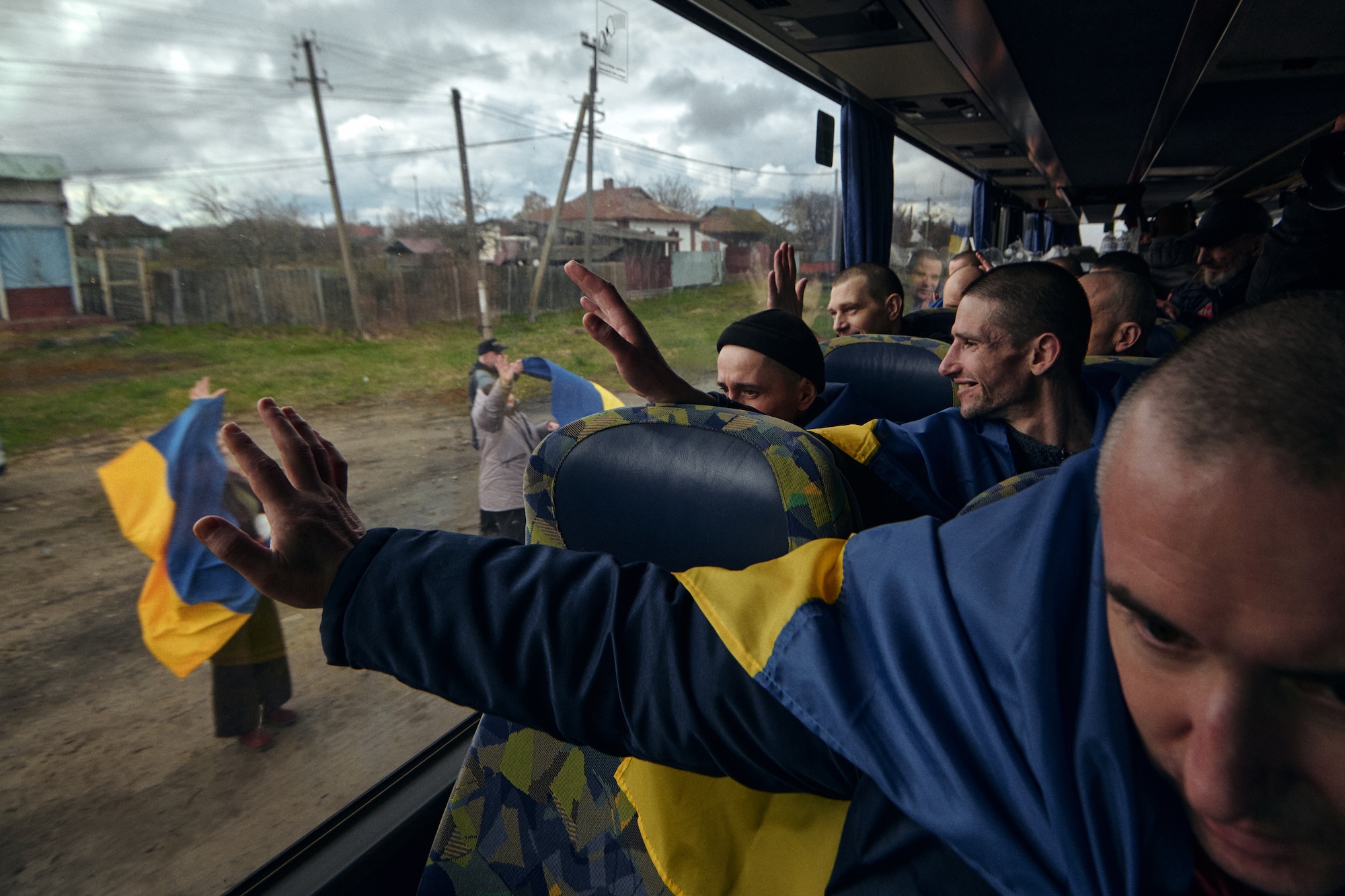
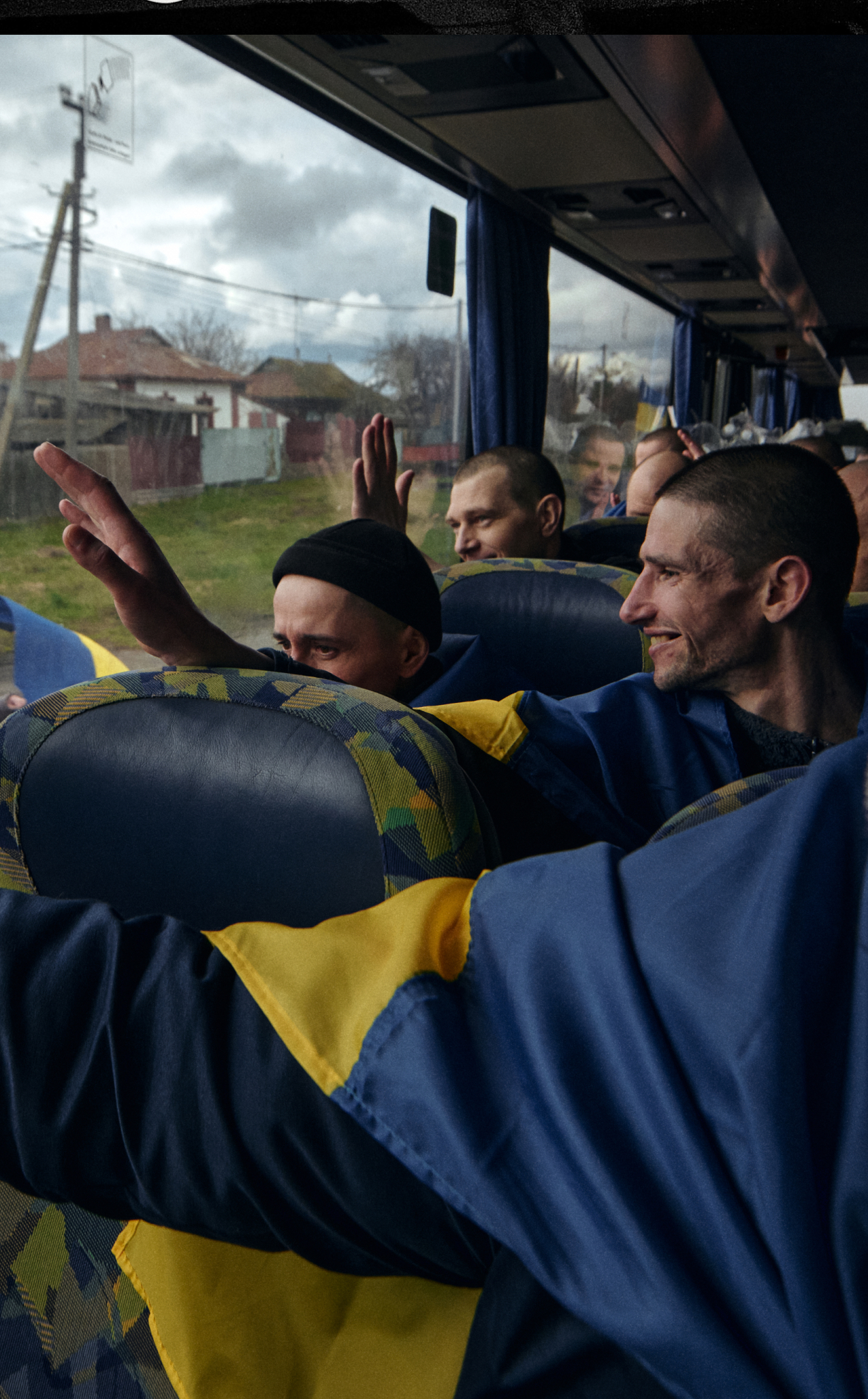
On the way from the border with Belarus, we pass through many villages. The residents of these villages know that in the morning, the buses go to pick up prisoners, and a few hours later, they would return with the released; and so, there’s a flag flying in front of almost every house to welcome our people home. The villagers come up with something new every time. Once, they sewed a flag several meters long; you couldn’t take your eyes off it, as it stretched along the road for at least ten seconds.
Those who come out to greet the released put aside their chores, grab their children and head to the road. They hurry to light the blue and yellow flares. Among the crowd are those whose son, father or husband is on the front lines; those whose family members are missing in action; those who have lost someone; there are the wounded who were discharged from the military on account of their health; and simply people from the community — because how could you miss something like this?
The buses carry strangers. Only one thing is known about them: they are Ukrainians who were held captive, survived torture and are returning home.
11.
Previously, when exchanges took place in Sumy Oblast, buses were allowed to stop along the way. The doors would open for half a minute, and the delighted villagers would throw boxes of gingerbread and crates of lemonade inside. Newly released prisoners aren’t allowed such food, so for a while, they’re deliberately isolated from their relatives to keep them from overeating the pastries and sausages they craved so much while in captivity. There are no such stops in Chernihiv Oblast.
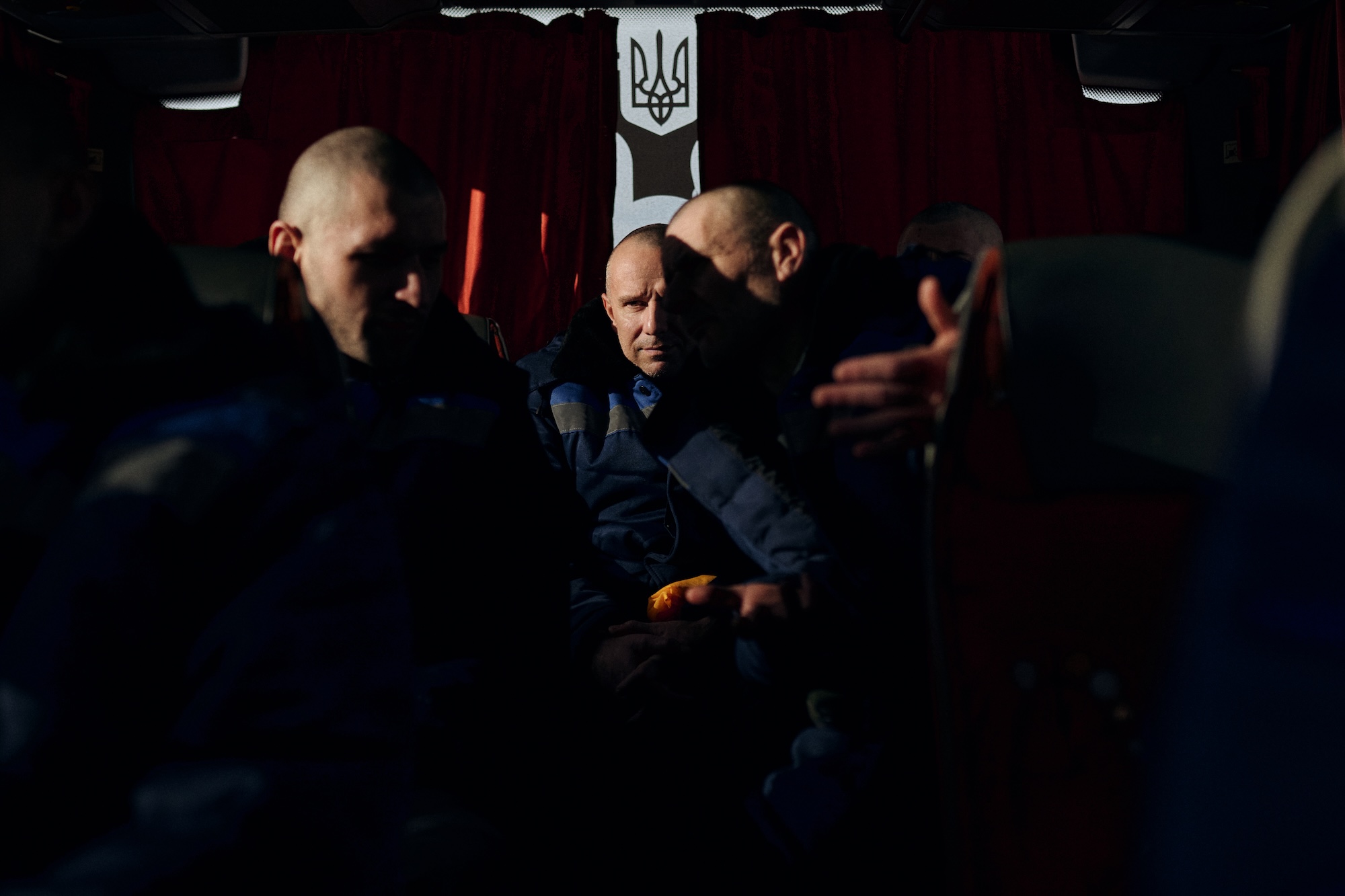
We’re on the bus with marines and paratroopers. We sing. We start with the national anthem. Then the guys lead us in three songs by the band “Tin Sontsia.”
The first is “Ares’ Sword.” Oleksandr had never heard the band perform it, but he learned the lyrics while in captivity: “…Ares’ sword will return our nation’s flag…”
Next, the group sings “The Cossacks Rode.” It’s about their fate and about true freedom.
And then — “We Were Born in a Great Hour.” Oleksiy sings it. He sings well, though his voice is hoarse from being sick. Oleksiy skips a verse — the one about living in chains as mute slaves.
12.
Residents of Chernihiv are also taking to the streets to wave to the freed prisoners. By this time, official reports are already coming in: an exchange has taken place.
The released prisoners can’t tear themselves away from the windows. The world on the other side of the glass is once again familiar: gas stations, supermarkets, people, trees, dogs on leashes. It’s been so long since they’ve seen the things so dear to them.
Relatives are already rushing to meet many of them. They’re trying to guess which bus their loved ones will get off. They’re anxious: will they recognize each other, will they be happy to see each other, will they have time to hug?
When they spot their loved one, they rush in for a hug. A brief moment together, and then they have to go inside: there’s food, a shower and clean clothes waiting.
The welcome ceremonies are boisterous. There are definitely more than a thousand people there to greet them, and they shout nonstop:
“Welcome home!”
“Is anyone here from the Kursk operation?”
“Thank you for coming home!”
“Marines, who’s from Mordovia?”
“Welcome home!”
“Look at the photo, please — maybe you’ve seen him!”
I see children being held up through the window — so their dad, grandpa, uncle or brother could hold them, even for a moment.
In a few hours, the crowd will disperse. But most will return here again for the next exchange.
13.
We try to give our contact information to those who were reunited with their loved ones so we can later send them photos and videos of their reunion, as a remembrance. When the quarantine ends, and the whole family is finally together, they sometimes send us photos of them eating cake together, taking their children to school, hugging each other or celebrating their first birthday outside captivity.
Sometimes those who have been released come to the exchange points. They approach us and say, “You were there to greet me when I returned.” Or, “I showed you my letters.” Or, “We sang together on the bus.”
And now we’re there together to welcome those who have returned.
When we get home, it’s already dark outside. I scroll through social media and like hundreds of posts. The photos are overwhelmed by the yellow and blue of the flags. There are screenshots of messages announcing the return of relatives and images of hugs from those lucky enough to meet their loved ones right as they stepped off the bus.
I post my own photos and videos — not for the hype, but so people can feel that the line of captives has moved forward by a few hundred people. I add the hashtag #OurPeopleAreHome. And I write that we’re rejoicing with those who’ve finally been reunited with their loved ones, and we’re sending our love to those who still have to wait.
14.
The bag of artifacts for Sasha is getting fuller. We drew a poster with that same poignant quote from “Harry Potter” and put it in with the wand, the owl and Dobby’s socks. We had to take out the Every Flavor Beans — a captive who’s just been freed isn’t allowed to eat that kind of food. We joke that if he doesn’t come back soon, we’ll have to buy a trailer just to haul our hallowed relics.
We have no reason to believe he’ll be back anytime soon. But we constantly tell ourselves — and write to him — that happiness can be found even in the darkest of times, if one only remembers to turn on the light. Last June, I made a promise: when he returns, I’ll tie the flag of hope around his shoulders.
We’re waiting, just like thousands of others.
“After all this time?”
“Always.”
This story culminates in hope emerging from years of despair. The main protagonist, Major Oleksandr Ivanov of the 36th Marine Brigade, returned home on 15 May after 4 years, 1 month and 3 days in captivity. His family and friends had envisioned their reunion a thousand times, yet on his first day of freedom, they were only able to hold him for a few fleeting seconds. But now, more than ever, this story is proof of why we must hold onto faith and keep waiting.