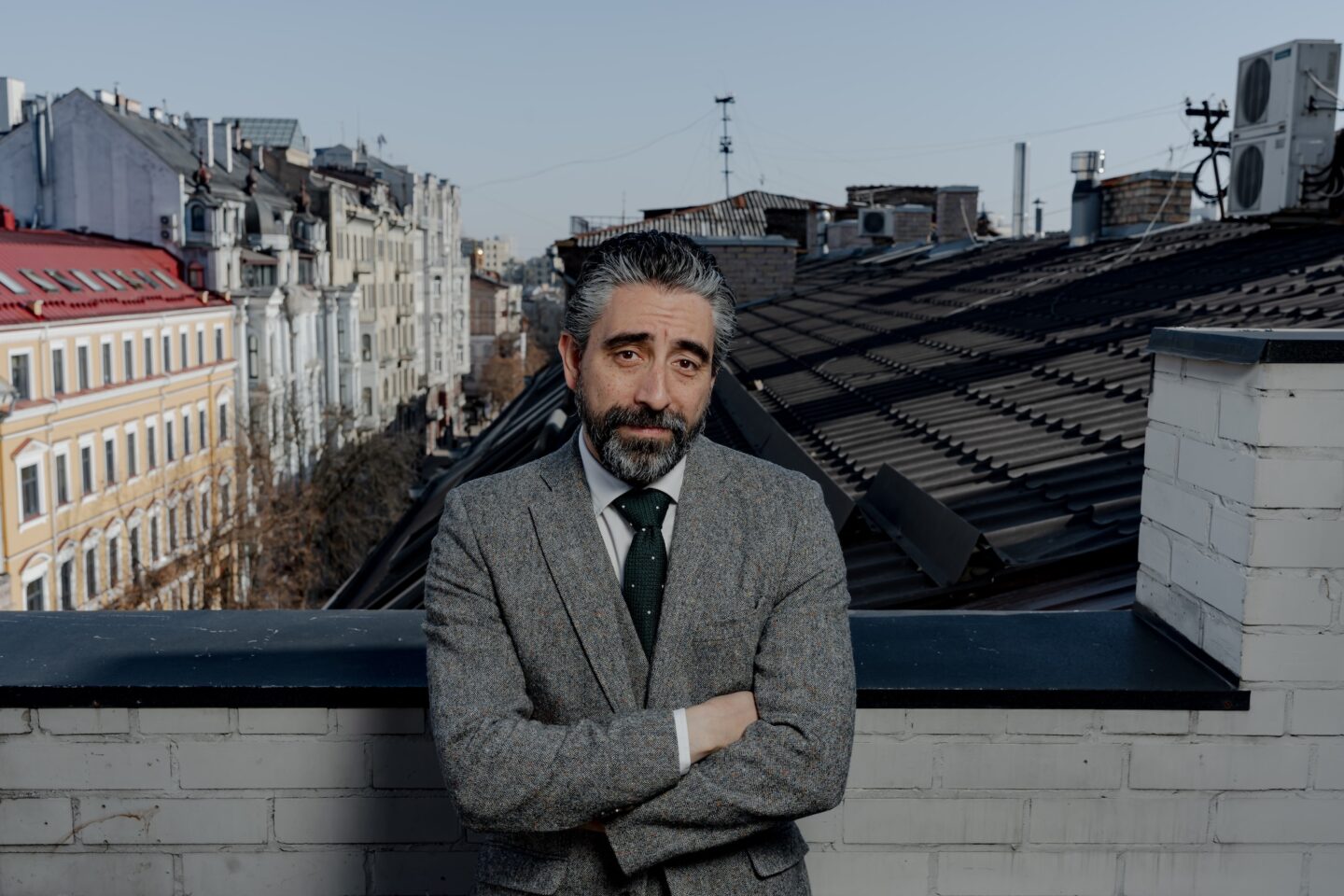
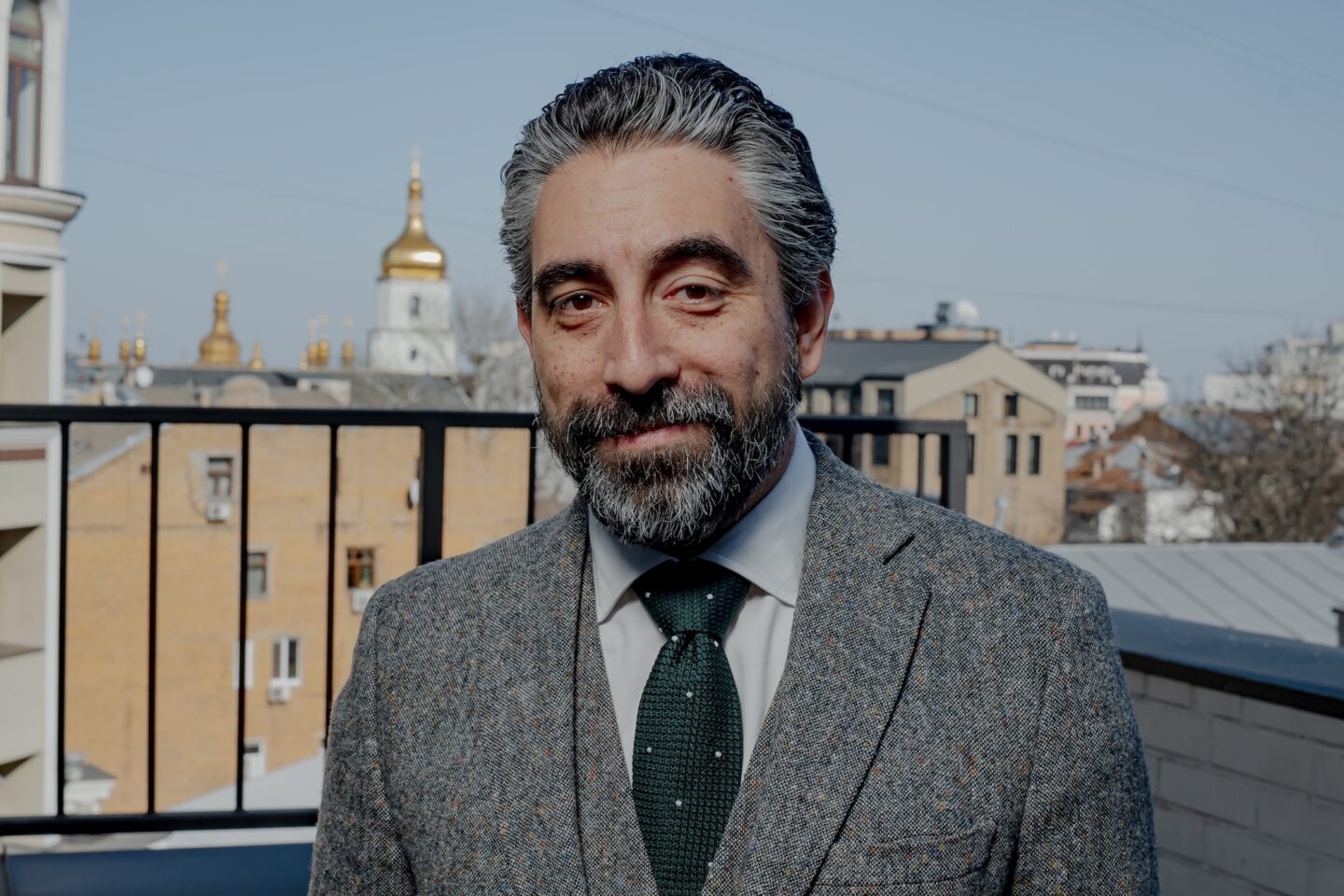
We met with war historian Jonathan Krause at the Peremoga coworking space in Kyiv, where he came to give lectures at the invitation of the Sahaidachnyi Security Center. A lecturer at Oxford and Sandhurst — one of the world’s most renowned institutions for training military leaders — he studies how states wage war and how societies adapt to them, from European conflicts to anti-colonial uprisings. In this conversation, Krause doesn’t talk about strategy, but about something else: what war really is, and why history can’t give us simple answers.
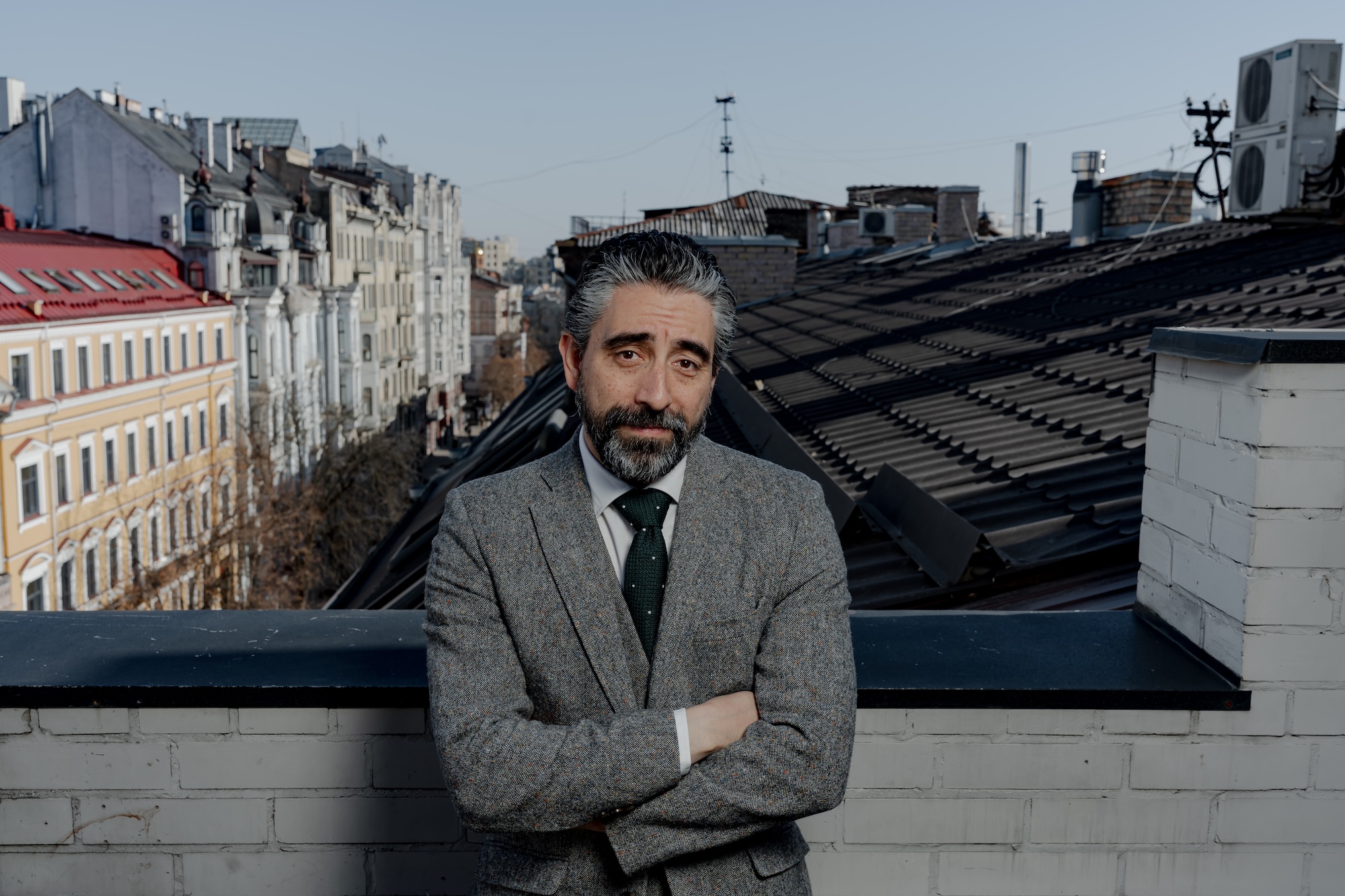
Jonathan Krause: ‘People may not realize it, but they influence the war in a million small ways’
A war historian on the psychology of empire, the past and the future
08.05.2026
08.05.2026
Loading the Elevenlabs Text to Speech AudioNative Player...
This audio is created with AI assistance
Jonathan, what are your first impressions of Kyiv and Ukraine? What surprised you the most
I’m not sure anything actually surprised me, because I have a lot of Ukrainian friends and colleagues who told me what Kyiv was like. But, of course, stories can’t compare to actually being here. First and foremost, I was struck by the city’s size and beauty, and how open, inquisitive, and engaging the people here are. Wherever I go, as soon as someone hears my accent, they stop me and start a conversation: “Oh my God, where are you from? What do you do?” I’ve met so many people here who are doing genuinely impressive things locally while also thinking and operating on a global scale. It’s incredible. For example, I’m from Los Angeles, and yesterday I met a young Ukrainian architect at a coffee shop who has designed spaces in LA. He showed me some of the projects he was working on there, and it was a wonderful reminder not only of how interconnected we all are, but also just how important and integral Ukraine and Ukrainians are to the rest of the world.
You started out studying history and then became a military historian. Why did you decide to focus on this aspect of history?
Well, as a child, I always wanted to play with toy guns, but my mom wouldn’t let me — she thought it was too violent. So I decided to do it as an adult — perhaps as an act of rebellion. But over time, as I delved deeper into the study of war, I began to see it differently. War is, sadly, one of the most common forms of human activity. People have always engaged in it and, unfortunately, always will. That’s why there is immense value in understanding it as deeply as possible — both as a society and as individuals.
Especially since 2022, this has become a personal mission for me: to help people better understand what war is — how it starts, how it affects those who experience it, and how we can and should respond to it.
It has become customary to view and study history primarily through the lens of wars and conquests. Do you agree with this approach?
It’s really interesting. If you walk into a bookstore and go to the history section — especially in the U.K. — “history” there actually means the history of wars. There might be a small section on monarchs or politics, but books about war dominate.
In the Western tradition, the oldest histories we have are actually histories of wars. So, there is something about war that captures the human imagination and memory more powerfully than perhaps anything else, and that does make a lot of sense.
With war comes loss, and when we lose people, we want to remember them.
We place a huge emphasis on memory and on preserving whatever we can of that pre-war life, and this perversely compels us to focus on war again and again. This means that many periods of history, all over the world, are actually counted or categorized by their wars. We use the term “interwar period” to refer to the 1920s and 1930s. What other time and space do you define by an absence of something? That’s really strange, isn’t it? In other periods of human history, when there might not be a war going on, or at least not a major one, we don’t call them “non-war.”
So I believe that war, as Clausewitz [a Prussian military commander, participant in the Napoleonic Wars, theorist and philosopher of war — Ed.] wrote, is a serious matter, and it demands serious attention, serious reflection, and a serious response. And perhaps this seriousness makes it more prominent in historical memory than other things that are no less important, like the economy, culture, art — everything that actually makes life possible and fulfilling. And there is a certain irony in this. We remember best what destroys us, and much less what sustains us.
You studied in the U.S. and then moved to the U.K. How do the academic environments of these two countries differ, and how did they shape you as a researcher?
When I was still studying in the U.S., I realized quite early on — around the age of 18 — that I wanted to be a historian. Even back then, I found war to be an interesting subject. I told my academic advisors about this, and they replied, “You shouldn’t. It’s career suicide.” And they were probably right.
In the United States, it’s very difficult to be a scholar of war and find a job. It’s not impossible, but the path is much narrower. The general advice I got was: focus on related topics — cultural, social or political history — through which you could then approach the subject of war. So, you can become a historian of culture, society or politics and eventually switch to focusing more directly on war.
In the United Kingdom, especially 20 years ago, the situation was different. There, studying war as a discrete subject was much easier and more natural. It didn’t carry the same political implications, or at least I didn’t feel like it to me. In the U.S., however — at least since the 1960s — interest in war is often perceived as a political stance. It’s as if the very choice of this topic automatically means you’re “pro-war”, or a right-wing radical, or whatever.
Imagine this scenario: an 18- or 19-year-old student in the U.S. tells their advisor, “I want to get a PhD in military studies.” And in response, they hear something like, “Does that mean you’re a Trump supporter? Are you a fascist?” — in other words, a reaction that has absolutely nothing to do with the subject itself.
In the U.K., this is also becoming the case increasingly, sadly. I’ve had students tell me that when they tell their friends they want to study war or work in the defense sector — in think tanks or government agencies or what have you — they often hear in response: “Oh, does that mean you’re a fascist?” This is a tragic response at a time when we can least afford it. Because now, more than ever, the U.K., the U.S. and Western Europe, in particular, really need to have a better understanding of war, and we risk losing the young people who could be doing critical war-related work in the future. This isn’t just about military expertise in the narrow sense. Given the apparent likelihood of large-scale wars becoming more and more common in the coming years or decades, we need brilliant young people who understand war across every domain: the technical, historical, theoretical, humanitarian and philosophical. And at the same time, we are making access to this knowledge, its acquisition, development and dissemination, increasingly difficult. And so we find ourselves trapped in a very complicated situation, which, in my opinion, was probably a little better 20 years ago — at least in the U.K.
How did the culture of studying war as an interdisciplinary phenomenon develop in the United Kingdom? And why does this topic remain politically sensitive in the United States?
In the United Kingdom, several institutions are dedicated to the study of war. One of them is the Department of War Studies at King’s College London, where I was educated. It was founded by the historian Sir Michael Howard and was, really, a product of the Cold War. Its creation reflected the idea that war is a complex and significant phenomenon that cannot be left solely to historians or political scientists. To truly understand it, you need multiple perspectives — law, sociology, psychology, history, economics — a truly interdisciplinary approach. And largely thanks to Howard and his colleagues, this intellectual culture in Britain took shape as we know it today. Without them, it would look entirely different.
The United Kingdom also benefits from having a national history and culture that is heavily centered on the experience of the Second World War. Today, both the United States and the United Kingdom base a significant part of their national identity on this period. Even I do, and I’m aware of it! It’s inescapable. My grandmother, when she was a young girl in London, survived the Blitz, the German bombing of British cities.
If three years ago someone had asked me whether I would ever drink tea in a city under bombardment myself, as she did, I would have said, “You’re out of your mind.”
of our reality, after just two generations. And we’re the lucky ones! This experience, it seems, gives the British a little more freedom to study war in a way that Americans don’t necessarily have, because Americans don’t have that same victim narrative or portray themselves as victims, despite Pearl Harbor. For similar reasons, it’s probably easier to study imperialism in the U.S. Although the United States has imperial traits, it doesn’t have the same historical memory of empire as Britain does.
In Britain, it’s difficult to write a history about empire that’s neutral: you have to be at least somewhat critical — in fact, very critical — otherwise you simply wouldn’t be taken seriously. And that’s understandable. Imperialism is horrible, and I would be suspicious of anyone who claimed that imperialism benefits anyone (although, as in every system, there are always individuals who find a way to sail with the prevailing winds and profit a bit themselves through empire, or whatever other oppressive structure).
But the way research is shaped and directed — often in very subtle ways, without overt pressure — has a long-term impact on what a country can or cannot study. And this, in turn, influences society, its culture, and how it responds to conflicts. Sometimes I ask myself: if the U.S. had greater freedom to conduct an in-depth, multifaceted study of war, would they be as eager to go to war as they are now? I’d like to believe not. But, unfortunately, the opposite effect is also possible — it could make them even more enthusiastic about war. And that would truly be a disaster.
They say that history teaches us only that it teaches us nothing. Do you agree?
Well, coming back to Michael Howard — who was, you could say, my academic “grandfather,” my supervisor’s supervisor at Oxford. In 1989, at the time of the Soviet Union’s collapse, he said in an interview (roughly paraphrased): “History tells us nothing — historians tell us things. And they are just as prone to error as anyone else. So be wary of those who put on the mask and say, “I am history, and this is what I tell you.” So, on the one hand, history cannot offer easy lessons. But it does offer something else — an opportunity to understand people a little better.
I’m a historian, so my sincere apologies to any quantum physicists reading this, I’m sadly going to butcher one of their great contributions to human knowledge in my ignorance. You will have heard of the concept of superposition — that reality exists not as a fixed, concrete certainty, but rather as a near-infinite series of probabilities. And so, if we look at life — at human decisions, whether individual, social or political — as well as at the conduct and outcome of war, as part of that long chain of probabilities, then hope emerges. By understanding patterns of the past — how people think and act under certain circumstances — we can gain a clearer sense of the probabilities and make slightly better decisions. So, if you make hundreds or thousands of decisions based on slightly better data, then, hopefully, your overall results will also be a little bit better — even if any single decision may not necessarily change or lead to a better or worse outcome.
Does history help us understand what is happening in Europe today?
Yes, in a sense. One of the keys to understanding this, to my mind, is the logic of empire. One of my greatest disappointments in 2022 was that many of my friends and colleagues who had opposed imperialism for decades turned out to be insufficiently critical of Russia, in my view. For various reasons, they either failed or refused to see what lay behind its actions — the motives, ambitions and, ultimately, the inevitable consequences. This is not just about war as such: the killing of civilians, the execution of prisoners of war, forced “re-education” in occupied territories, the mass abduction of children. None of this is unique. These phenomena have a long tail of heartbreaking precedents — particularly so in the history of land-based empires that pursue this kind of expansion.
If we compare this to, say, the United States’ and Canada’s policies toward Indigenous peoples in the 1870s–1890s, or indeed before and after, the parallels are pretty obvious. Children are taken from their families, forced to speak a language not their own, and sent to schools designed to erase their culture and replace it with the new imperial one. This has happened before. Such practices have been repeated many times throughout history, especially in land-based empires — probably because they lack the distance that bodies of water provide. So, when peoples exist as neighbors but have different languages, histories, cultures and ways of thinking — as in the case of Ukrainians and Russians — the imperial power can’t accept this. Such difference is a living argument against empire; it demands independence, uniqueness and individuality — everything that empire seeks to destroy.
The Russian Empire sought to turn everyone into Russians.
In its later years, the Ottoman Empire sought to turn everyone into Ottomans. But such efforts are always futile. So, of course, there are parallels and analogies. Knowing about this doesn’t guarantee that such processes can be prevented, but it does allow us to spot their signs earlier — and, perhaps, to respond better or at least mitigate their consequences. If we look at Russia’s history, the idea that after 1989–1991 it would never again try to expand westward was truly absurd. It is a recurring cycle with brief intervals, which proved quite short-lived in this case. First came political and economic pressure; later, open military aggression.
Are there any patterns in the history of wars that humanity stubbornly ignores?
Sure. It seems to me that — both in the past and today — we define the boundaries of war too narrowly. In reality, war extends far beyond its discrete geographical or temporal confines. I’m actually finishing writing a book on anti-colonial uprisings during the First World War. The people I write about were from Sudan, Nigeria, Senegal, New Caledonia, Vietnam, Ukraine, Kazakhstan — places perceived as peripheral, unimportant, or even “outside the war.” But their impact was enormous. First and foremost, it was economic. Even a hundred years ago, the global economy was interconnected. When war broke out, its consequences were quickly felt far beyond the front lines. For example, the loss of readily available Ukrainian grain almost immediately led to food scarcity in various parts of the world, especially in South Asia and Africa.
The military impact on these more remote regions was profound and extended far beyond the “canonical” battlefronts. The large-scale anti-colonial uprisings in West Africa during the First World War were just as much a part of that war as Verdun or the Somme, the Battle of Riga, or any other famous battles. People don’t recognize this because it doesn’t fit into the usual narrative. If we apply this to today, people in Argentina, California, the United Kingdom or Portugal might think this war doesn’t concern them, but that’s not true at all. The war affects them — and they, in turn, affect the war.
People don’t realize it, but they influence the war in a million little ways.
Every time they interact with systems related to Russian exports, when they pay taxes, part of which goes toward military spending, the little things they privately share with their friends or family, when they post something on social media — all of this takes place in the context of the war and, in one way or another, influences it.
On an individual level, this might seem insignificant, but when multiplied by hundreds of millions or billions of people, the cumulative effect becomes colossal. We forget this because we get caught up in our own petty problems or mistakes: the train is late (never here, but all the time in the U.K.), the internet isn’t working (never here, but all the time in the U.K.). And we forget that, in reality, we are all global players, and every small decision we make exists within this broader context. We build the world — moment by moment, day by day — which is both inspiring and can make us feel truly quite small at times.
I hope that studying the past can remind us of the power of an individual, of a single decision, or some small act of love or kindness.
Because, multiplied by billions, it becomes something far larger.
If aggressive war is a marker of empires (or imperial phantom pains), does that mean that if there are no empires, there will be no wars? Or is it some kind of a new utopia?
There is no such thing as a world without empires.
Not even in the future?
It’s impossible. At least, historical experience gives us reason to be skeptical. My former colleague and one of the scholars I look up to, John Darwin, writes in his book “After Tamerlane” (paraphrased) that an empire is likely the most typical form of political organization in human history. He describes an empire very simply: it is the rule of one people over another. So, if you are Welsh today, no matter what you think of Great Britain, no matter how you feel about your own country, strictly speaking, you live within the English empire. The English have all the money; they hold the overwhelming majority of political power and make up the overwhelming majority of the population. Even if you speak Welsh at home, when you do business, you most likely speak English, not Welsh. And this sort of thing happens all over the world.
If you live in the parts of the Russian Federation located in Central Asia, you live in an empire. If you are Hawaiian or a member of a Native American nation — Lakota, Cheyenne or any other — you live in the American empire. Even these nations were empires themselves. I tell my students: wherever you look, it’s empire upon empire. It’s simply the way people operate.
Let’s try to imagine a future in which, for some reason, there are no empires and every nation, however it is defined, governs itself. Sooner or later, one nation would begin to gain control over another through economic, political, cultural or military means — it is inevitable! And from this advantage grows influence and from influence — expansion. This continues until that power encounters another power large enough to stop it, usually another empire.
From a European perspective, the British and French conquest of Africa in the 1870s and 1880s is often portrayed as Europeans arriving and subjugating African societies that were supposedly ethnically homogeneous. But this is absurd. Even small communities were usually very diverse, ethnically and linguistically. People lived in complex networks of connections, with intersecting identities, as is, after all, the case everywhere else in the world. It takes only a few generations of intermarriage, migration and contact, and no community is “pure” or homogeneous anymore. If you are Wolof and see a cute Serer girl, marry her and move to her village, it doesn’t take long for it to become a mixed community. So in Africa, as in other parts of the world, European empires often encountered not “empty space,” but other African entities — very often of an imperial nature as well: the Sokoto Caliphate, the Ashanti Empire, Benin and countless others. And this, unfortunately, is the normal course of action for human societies.
If we take a closer look, Kyiv, where we’re sitting right now, was also at the crossroads of empires. In the 20th century, over a very short period, the city passed under the control of various empires, most notably the Polish and Russian ones. And if we broaden our perspective to, say, Western Ukraine, this story becomes even more complex. So, empires are everywhere and in this history, we almost always find ourselves simultaneously in the role of both the conquerors and the conquered.
From a humanistic perspective, war is always bad because it brings death, suffering and destruction. But is war ever studied as a positive phenomenon?
It has been for many years, but rather less so now. When I first meet students, whether they’re first-year undergraduates or army officers, I ask the same question: “What is war?” Those who are a bit more well-read sometimes answer: “War is politics by other means.” All right, that’s Clausewitz. But to make them think, I answer this question this way: war is the killing of civilians and the destruction of their property. It is comparatively rare to find a war in which the military bears a greater burden of suffering and loss than civilians, which runs counter to every cultural expectation we have of war.
If we look at the Second World War, hopefully the biggest we will ever fight, although I doubt it, the scale of military casualties was truly staggering. But the losses among the civilian population were somehow even greater. There are isolated cases where the military suffers greater losses — both human and material — than civilians. But these are usually smaller, short-lived and isolated conflicts. In most wars, the opposite is true.
In any conflict, as soon as the war reaches cities and broad segments of the population, civilians suffer. For a long time, I hoped — though I have far less hope now than I did before — that if those in power truly understood this, it might make war less likely. Because, in essence, the decision to start a war means killing civilians to achieve political goals. This is entirely different from saying, “We are striking military targets to neutralize them and protect our interests.” Such language sounds clean and rational, as if there were nothing too terrible behind it.
If we were to say outright, “We want to enrich our country by killing their civilians and seizing their natural resources,” that would be much harder to sell. But, in essence, that is largely what war is.
If we look at Russia’s war against Ukraine from this perspective, on one level, it’s no different: we want to kill Ukrainian civilians and seize Ukraine’s raw materials and human resources. Even states that are less directly involved in this war, such as the United States of America (at least under the current administration), are willing to accept the deaths of Ukrainian civilians due to insufficient military, financial or air defense support in exchange for being able to profit from Ukraine’s resources, both human and physical, in the future. This, in my view, is the fundamental nature of war.
You mentioned the famous Clausewitz quote about war as the continuation of politics by other means. But how relevant are historical military experience, strategy, tactics, theory and philosophy today? How relevant are figures like Clausewitz, Napoleon, Suvorov, Sahaidachnyi or Sun Tzu? After all, it is often said that a completely different war is currently being waged in Ukraine — a war of new technologies, which requires new tactics.
My first reaction as a historian to any “new” phenomenon is to question its novelty. Almost everything has already happened before. Take drones, for example. Essentially, they are just another way to kill from a distance. Ever since humans were able to throw stones, the logic of ranged warfare has not changed. Only the means change — they become more effective, cheaper or more accessible, but it’s all driven by the same idea. This doesn’t mean that drones haven’t changed anything. At the tactical level, they have indeed forced a rethinking of warfare and a rewriting of military tactics around the world. Ukrainians are receiving great praise for this, and they deserve it, but their innovations would have likely happened anyway eventually; it was an inevitable development. As far back as 10–15 years ago, drones were used by, among others, Hezbollah, weren’t they? In other words, drones were never the exclusive domain of states or large armies. For a long time, they have been a way for armed forces to do more with less. When firepower increases — as it does with the advent of drones — and at the same time the ability to quickly detect and strike targets grows, it brings the warring parties to a stalemate.
Further reading
Anne Applebaum: ‘People from all over the world will come here to learn’
A conversation about the distortion of history, persisting imperial ideas and Ukraine in 10 years
Thinking about Europe from Ukraine
Do they fully realize what is at stake?
Timothy Garton Ash: ‘We’re Living Through a Defining Moment in European History’
A British historian on the hell of war, the power of memory, and the turning point in European history
On the eve of the First World War, the development of rapid-fire artillery had a similar effect. After the French developed the first hydraulic recoil system in 1897, artillery was able to fire at a rate of 15–20 rounds per minute instead of just one or two. As a result, such a concentration of firepower located in a limited area made large-scale troop advances practically impossible, as it became too dangerous.
Drones have done the same. So how are armies responding to that? Troops are going underground, attacking and defending with far fewer people. So, you have fewer people defending a much larger territory. An expanded “gray zone,” as we call it today, emerges, and progress becomes very difficult, with attrition becoming the only way forward.
If we look at the battles of 1918, the Germans, who were on the defensive from July onwards, dug fewer and fewer trenches. It wasn’t like it was in 1915. They were fighting in small, isolated strongpoints from which they could later (or never) retreat. If we look at the Ukrainian defense today, we see the same thing. Even trenches, if they get too large, become conspicuous and vulnerable, so troops disperse, hide, reduce their visibility and force the enemy to fight in a confusing, empty space where, ideally, the only thing they encounter is firepower, not people. This is an extremely complex tactical problem that needs to be solved. And this is the problem that the Russians have not and, I believe, will not solve.
As a historian, how do you explain the current Russo-Ukrainian war within a broader historical context, given that we are witnessing a crisis in international law and challenges to the European and global security systems?
In several different ways. If we speak of the region conventionally referred to as Eastern Europe or the Slavic world — though this definition is imprecise and covers a much broader territory — then at least over the last century, and in fact for much longer, identity has been a key driver of conflict there. The Balkan Wars at the beginning of the 20th century largely revolved around the question of what it means to be Bulgarian, Serbian or someone else, and where the boundaries of this identity lie. The wars over Poland, the war between Poland and the Soviet Union, were about something similar — about how far the Polish language could extend. You can feel it even in the little details. Sitting here in Kyiv, we could ask: are we drinking “chai” or “herbata”? Most likely, it’s “chai.”
So, if we look back to 2021–2022 and the period leading up to the full-scale invasion, Putin often spoke about history and Ukrainians. It’s clear that both the past and identity — the idea of who we are — lie at the very heart of this conflict. What does it mean to be Ukrainian? What does it mean to live in this space, to speak this language? What does it mean to share a common and intertwined history with other people throughout the Slavic world and Eastern Europe? These histories are shared; they are intertwined, but intertconnectedness does not mean sameness. If we had a camera right now, readers would see a small tree next to us. Its branches intertwine, forming a single shape.
Yes, it is one tree, but each branch is separate, individual: it has its own life, its own history, its own scars. And it is by these scars that we recognize them.
Unfortunately, this mix of contested identity — or the use of identity as a pretext for advancing an empire — means that the history of imperialism is almost always accompanied by deeply-rooted paranoia. Empires, despite their power — or perhaps because of it — are often extremely paranoid. And this applies not only to empires. Great wealth is accompanied by high walls, dogs, armed guards and security systems protecting the home. An ordinary person or someone from the working class faces a much higher risk of violent crime than a billionaire. But who spends more money on their own protection? Who is more paranoid? It’s the people who are the most influential and have the most money. And that’s really strange, because in reality, they’re the safest. Empire is driven by the same psychology.
When it comes to Russia, let’s face the facts: as a state, they are safe. Let’s return to one of the many excuses Russia has used — that NATO was expanding eastward. Was NATO planning to invade and conquer Russia? Obviously not. Instead, the logic of paranoia dictates something else: the very existence of anyone nearby is a threat, and that threat must be eliminated. And the same, unfortunately, applies to every Russian ruler for at least the last three centuries who sought security in the West. This applies to both Stalin and Putin, to say nothing of Peter and Catherine. And the way their paranoia is reflected not only in their foreign policy but also in their domestic policy is truly striking and should frighten anyone, as well as give us some insights and clues about the kind of leader we are dealing with.
Can this war change Europe’s perception of itself? Will it change Europe?
Yes, definitely. It’s already changing — and, in my opinion, it will continue to change. And I’m actually quite optimistic on that front. My friend Olesya Khromeychuk’s brother, Volodya, was killed in Donbas in 2017. Before he died, he said something to the effect of, “We are fighting a European war — Europe just doesn’t realize it yet.” It seems to me that Europe is gradually beginning to understand what he was talking about almost a decade ago. But not fully. This is, in essence, a European war, which is partly why I’m here. When my mom, who’s safe in Los Angeles, asked me, “Why are you going to Kyiv? What good will come of it?” I thought: yes, I’m an American. But, in a sense — at least legally — I’m also European. And if there’s a war in Europe that I can influence in any way, then I have a responsibility to do so.
We can all do small things: help, give, support. And Europeans shouldn’t think that this is solely the responsibility of governments. That’s not the case.
Europeans, as individuals and as societies, also bear responsibility for the eventual outcome of the war in Europe, Russia’s war against Ukraine, and they should act like it. As I’ve said before, we all build the world every time we wake up. Proust writes about that brief moment between waking and opening one’s eyes, when he creates reality by opening his eyes and bringing it into existence. We do this every day. So take responsibility for the world you create simply by opening your eyes in the morning. Do something. Anything.
One of the questions that truly concerns many people today is the role of civil society. Has people’s sense of responsibility toward their own state changed, especially in Western Europe, after 1945?
Most likely yes. And I hope that the experience of Russia’s war against Ukraine — and the example set by the Ukrainians themselves — will serve as a reminder: you cannot sit idly by and simply let your government function. You cannot simply assume that they will do everything, and that none of it is your responsibility. As a member of society, you are obligated to participate and make your contribution, whatever it might be.
When I was growing up in America, we were often told the words of President John F. Kennedy: “Ask not what your country can do for you — ask what you can do for your country.” I didn’t understand it back then. I thought: that’s nonsense! Why does the country need something from me, and why should I give my time and money and expect nothing in return? It was a horribly naive and privileged view of life and the world. And I think Ukraine’s experience — especially since 2014 — very clearly shows what Kennedy meant. As someone who went to war himself, he understood that societies do not exist on their own, independent of their members. We create society, and we are responsible for it. And if there has been, at least since the 1970s, this dream of a more united Europe — one that is more aware of its shared history — then it also means that Western Europeans need to take their responsibility toward the rest of Europe more seriously.
You asked how this could change Europe. For example, more and more people in Western Europe now consider Poland part of Central Europe. That would never have happened five, 10, or 20 years ago — it was the “East.” If I go back to my childhood, even Czechoslovakia was “Eastern Europe,” which, if you look at a map, is crazy. But over the past few decades, Europe’s borders have expanded significantly to the east, culturally, politically, intellectually. And Ukrainians, intentionally or not, are fighting and dying, in part, to continue to change this perception of Europe and its borders.
I hope that over time this will mean a much stronger and deeper integration of Ukraine — Ukrainians, Ukrainian history, art and literature — into the broader European mainstream.
Over the past few days, and in our conversation today, I’ve mentioned various authors, writers, artists — you name it. But notice I haven’t mentioned any Ukrainian ones. Because I haven’t read them. And that’s a problem. Therefore, a more serious approach to our shared culture will shape Europe’s intellectual and cultural borders in ways that seemed unthinkable just ten years ago. This will enrich us all — emotionally, culturally, intellectually, philosophically.
I hope that Ukraine is finally being perceived and regarded as part of Europe and as a factor contributing to European security. But what, in your opinion, does the world still not fully understand about Ukraine?
A lot. Although I’m no expert on Ukraine… So, what don’t people understand about Ukrainians? That Ukrainians are people, and that they live just like everyone else. Absolutely no one who doesn’t know Ukrainians well or has never been to Ukraine can imagine just how amazing Ukrainian cuisine is. And food is, after all, such a wonderful expression of culture and imagination, is it not? We often don’t notice this simply because, if we’re lucky, we have it every day, but it’s true. People always want to fit others into understandable categories. And when we say something like, “Ukrainians are resilient,” we mean it as a compliment. And it really is a compliment. But not everyone fully realizes the complexity behind these words, and how they grate on those who hear them repeated, over and over again.
It seems to me that people from the outside don’t fully understand — after all, I’m still learning to understand this myself — just how complex Ukrainians’ relationship with the war is. On the one hand, it is the central topic of any conversation, whether it is spoken about or not. But at the same time, Ukrainians, especially when talking to foreigners, know full well: the moment the person they’re talking to finds out they’re dealing with a Ukrainian, the war instantly becomes the first topic of conversation. And that’s exhausting. Many foreigners find this hard to grasp. It might seem like a series of paradoxes to them, though in reality it isn’t. No one wants to be viewed simplistically: you’re Ukrainian — therefore, you’re first and foremost a victim of war. I think of some of my other friends or colleagues, regardless of whether they’re displaced persons or not; part of their identity inevitably becomes the lens through which outsiders perceive them. So, I think addressing this — without ignoring it (and that is a delicate balancing act) — would be truly helpful for people who don’t know a single Ukrainian or have never been to Ukraine.
You work with oral history, whereas academic history largely relies on official documents. Why are people’s voices and personal testimonies important? How reliable are they, given the subjectivity and selectivity of human memory?
If I asked you what you had for lunch yesterday, you would most likely say, “It was a good lunch.” You might not think about — or even remember — that the bread was a little stale, or that you didn’t digest so well; you simply form a rough impression, which then becomes reality. We really remember through our emotions and sense of smell. But I can’t record smells — I can only capture emotions. And that’s why it’s amazing that in oral history, the question of factual accuracy isn’t really that relevant, because people retain emotional realities.
If I want to know the factual reality of a particular day or moment, I can most likely find it somewhere in a document; the great thing about documents is that once you write something down, unless you lose it, it stays there forever. Memories, emotions, little stories or jokes, on the other hand, are lost almost instantly if they aren’t recorded. So one of the greatest joys and privileges of oral history is the ability to preserve what would otherwise quickly disappear, and which is the most human element of the human experience. After all, we live our lives subjectively.
My work at the University of Oxford focuses on the oral history of the Royal Army Medical Corps, and this perspective on war is endlessly fascinating. When people study war, they usually turn immediately to violence, to the front lines. And yes, the front lines are obviously critical. As Clausewitz wrote, combat is the central element of military activity. But looking at war from a medical perspective integrates war with a humanitarian perspective at every level. When I interview elderly British medics, whether they were combat medics or surgeons, almost every one of them provided medical care to combatants or civilians on the other side. And they all spoke with those people. So, even though they wear the uniform, say, of the British Army, they exist in this liminal space that’s partly military, partly humanitarian — partly British, partly Iraqi, Afghan or some other. And this is an absolutely unique perspective and experience that people who haven’t thought about it don’t often appreciate or understand.
Identities that seem contradictory often blend together very easily, because we are all full of contradictions. We all have flaws. I have plenty of them. For example, I spend more money on clothes than I should. We can call it vanity. Yesterday, The Ukrainians were taking my picture, and it was probably the worst experience I’ve had in Ukraine. The photographer asked me to look serious, to pose this or that way, but the only thing I wanted to do was joke around. Make her laugh. I made her job incredibly difficult, and I’d like to apologize to her — she was extremely professional, and I wasn’t. That’s a contradiction, though, isn’t it? You’d think someone who cares about their appearance would enjoy that. But no. Maybe I was just having a bad hair day, who knows.
Oral history is precisely what allows us to exist within these contradictions. It helps us not to lose sight of the humanity within us and the human, humanitarian dimension in history. And this is important, because as people, we constantly strive to simplify things. We want everything to be clear, unambiguous, easy to explain and repeatable. Although in reality, we ourselves are not simple, not unambiguous and certainly not easily reduced to simplification.
Is global peace possible in the 21st century, especially given that you insist that empires will always exist?
Empire, by its very nature, is a form of violence. One people can not rule over another without violence, without the threat of violence or the use of violence (in reality, there is not much difference between the two; threats are also inherently violent). Therefore, as unfortunate as that is, humanity is incapable of completely eradicating war. Let’s even imagine a fantastical scenario: there is a single world government, we can all vote, and it governs us as one human race. Even this would not eliminate conflict. Criminal groups would remain, still fighting for the same things that nations fight for today: territory, resources, money, identity — and since people are also a resource, they’ll fight for the control of towns and villages, too. People won’t stop fighting, just as they won’t stop lying, stealing, arguing or being selfish. It’s human nature.
What question about war do you think humanity has not yet learned to ask, but should?
We often ask, “Why do people wage war?” But we almost never ask, “How do they do it?” And I’m not referring to tactics, but to the human dimension. The way we wage war says a lot about us as individuals, as societies, and as a species. And by “how,” I mean every element: how we treat our serving soldiers, how we treat veterans, what means by which we choose to kill and injure other people. Every war is barbaric, but barbarism changes. Today, asphyxiating chemicals could be used on a massive scale in war, but that isn’t happening. Why? In the 1920s, some thinkers argued that future wars would become “more humane”: they claimed it would be possible to create non-lethal chemical agents that would merely incapacitate the enemy, and thus wars could be waged without bloodshed — at least in theory. In the end, we went the opposite way. We have largely abandoned chemical weapons and, at the same time, increased lethality. That’s fascinating.
On the other hand, aren’t armies, by their very nature, meant to kill? But at the same time, from a humanitarian perspective, shouldn’t armies seek ways to be effective without killing? Sun Tzu wrote about this: the highest level of military art is victory without fighting. The so-called “cabinet wars” (Kabinettskriegs) of the 18th century were partly guided by a similar logic. So I think people should ask not only the question, “Why does war exist?”, but also, “What does it say about us and our societies?” And the answers to that question will not always be easy.
Translated from the Ukrainian by Liubov Kukharenko