
Carrying a Warrior’s Child
This essay was made possible thanks to the support of The Ukrainians Media community — hundreds of people who believe in independent, high-quality journalism. If you value our work, consider supporting us and help us tell more meaningful stories.
“We got the L200 — I’mma call him on Signal. Tell the commander I’m on my way,” men in tactical clothing chatter near a scuffed-up pickup truck somewhere in a frontline city.
“Honey, you do that to him again, and I will end you!” A disheveled mother of two toddlers racing ahead of her on a balance bike and a scooter interrupts the soldiers’ conversation.
“It’s not working out between Tania and me…” As I walk, I overhear a young guy in a tracksuit confiding in an old man near the building entrance. “How come?” says the old man in surprise. “Your star signs are a perfect match!”
Meanwhile, in a small café nearby, the life-affirming “Volare, ooooh, cantare, ooooh” plays against the backdrop of a shrill siren and the announcement: “Air raid alert. Threat of guided bombs. Please proceed to the shelter,” to which none of the aforementioned locals react. Except for the old man, who sighs (either because of hearing yet another siren or the young man’s confession) and raises an eyebrow, quickly returning to the conversation about Tania.
That’s how my days would go when I visited the frontline towns. In between brief encounters with my husband, interviewing soldiers for my podcast, and delivering cars and supplies to various units, I’d wander the streets of these cities and towns, soaking up the local vibe. This lifestyle was quite different from the relatively measured pace I was used to in Lviv. And it does have its own beauty — you live as if every day is your last, because in those few short hours with your loved one, you manage to do much more than some people do in years in peaceful cities.
And then my husband would leave for a mission, and I’d return home and try to find the money to buy another car for yet another unit — and this way, have another chance to see him.
But one time, everything went differently. A few weeks after one of my trips, I found out I was pregnant. I sat there for about three hours staring at the test, smoking one cigarette after another. Then I took three more tests. Then I edited a podcast. Later, I looked at the tests again. I threw away the pack of cigarettes. Then I filled out a customs declaration for yet another car for the frontline, paid the bills for drone detectors and generators and then stared at the test again.
It was a much-wanted child, and the news made my heart race.
But I couldn’t imagine how to balance pregnancy with my work in the combat zone (I’m not in the military — I’m a war correspondent) and besides… Would I be able to handle carrying a child while worrying about my husband, a Marine, with whom I could lose contact for days on end? After all, he didn’t serve in a rear-area town — he was right in the thick of it. And because of that, my heart no longer pounded — it froze with uncertainty. But my husband, like a true Marine, said that there are no missions that can’t be accomplished, and that together we’d get through it. So I continued with the pregnancy.
It’s true — it was a pregnancy filled with anxiety, which could only be briefly stifled by a sense of responsibility for my older son, a first-grader or by my work and even more so by my volunteer work: I continued fundraising, buying drones and electronic warfare equipment and even managed to deliver some cars to the front myself. All of this took a great deal of time and effort; sometimes I forgot to eat, and sometimes I even forgot that I was pregnant. Some might say that pregnancy should be accompanied by peace and quiet, that it’s all about going to manicures and having coffee with friends. But that’s not how it works: pregnancy unfolds as your circumstances and conditions dictate, especially when you’re the wife of a soldier during wartime, a soldier deployed to a dangerous hotspot. So it’s better for the pregnancy to go hand in hand with a fast-paced life and multitasking than to spend your time sitting by the window, agonizing over devastating news and never-ending obituaries. And you certainly shouldn’t beat yourself up when you serve your older child a fast-food dinner (it’s still food) or the occasional cigarette you smoke.
But with nightfall, the fear would return. I couldn’t fall asleep until he texted to say he was okay; I’d set my phone to the loudest setting and put it under my pillow, hoping he’d text during the night. In the morning, I’d take my older son to school, and during the minute of silence, I’d sob (pregnancy hormones mess with your body like crazy — they don’t take into account that there’s a war going on), and then the panic would set in, a fog so thick that I couldn’t always get to work on time. Sometimes I even had panic attacks — my whole body would stop responding (during such moments, I was most afraid of being behind the wheel, especially with my child in the car; so I’d immediately look for a spot on the side of the road to wait it out).
And then a second checkmark would appear in our Signal chat. A few minutes later, both checkmarks would fill in, and “typing…” would appear next to my husband’s username, and the long-awaited message would arrive. My heart would calm, and the whirlwind of panic and emotions inside me would quickly subside — I’d make some coffee and talk to him for a few minutes. I’d tell him that I could feel our baby moving, send him a photo of the latest ultrasound, and hear his voice tremble as he struggled to hold back tears. And I’d feel the same way. He’d ask what we needed to buy for the baby and why I hadn’t packed my hospital bag yet. Then we’d discuss together what we’ll name the baby and who we’ll choose as godparents. A brief conversation — and by evening, I’d have the strength to live and move forward again. But then the anxiety would creep up on me again, building up and lodging itself in my throat.
A few months before I got pregnant, my husband’s best friend was killed in action. He didn’t live to see the birth of his child. I read his wife’s social media posts and sobbed together with her — I don’t know if there could be any greater pain than losing the person who was your whole world. My husband took over her husband’s duties, and shortly after that, I became pregnant. So now I was constantly haunted by the thought of whether our little one would ever get to meet his dad, whether he’d get to hear his voice, and whether my husband would be with me during the birth. I know that we all have different fates and life stories, but fear is a terrible thing — obsessive and uncontrollable; it gnaws away quickly and mercilessly, hammering even the most far-fetched scenarios into your mind. What hurt the most, though, were the questions asked by those around me.
People asked me what I would do “if he didn’t come back” or “if he comes back without an arm or a leg.” “What if, in addition to the baby, you’d have to take care of him too?” “Why are you having a baby if he’s over there?” “Couldn’t you have waited until it’s all over?” “How will you manage with two kids on your own?” “He should pay someone off and get discharged — people do that all the time!” “Yesterday, a woman saved her son from the draft officers — serves them right, the scumbags — but what about yours? He’s still out there!” And… the icing on the cake: “At least, if anything happens to him, you’ll get the money.”
I brushed off these “experts.” Often, without mincing my words. If you hear even one such question during your pregnancy, get as far away from the people who asked it as possible.
My two girlfriends and my mom became my rock: they knew when to stay silent, when to come over, when to help and when to take my car in for repairs — and most importantly, how to make sure the others didn’t bother me.
Our empathy towards one another is slowly eroding.
I’d go to doctor’s appointments and ultrasounds on my own, waiting silently in the hallway, surrounded by sweet couples — the men held their wives’ hands and stroked their bellies. I’d close my eyes so I wouldn’t burst into tears right there in the waiting room (it’s the hormones, you know?). I didn’t pack a bag for the maternity ward because the whole process annoyed and hurt me terribly. But every time I went to the maternity ward for a checkup, I’d see some big guy lugging that damn bag and accompanying his wife to the delivery room. They had everything thought out and planned down to the smallest detail: the two of them would dutifully go to ultrasounds and checkups together, shop for beautiful baby clothes together (a whole bagful), and when contractions started, he’d run to warm up the car, load the bag into it and drive his wife to the hospital. And while I was watching these totally normal hospital scenes unfold, my husband was warming up his military pickup truck somewhere around Pokrovsk. Will he be there to warm up our car when my contractions start?
During my pregnancy, I plucked up the courage to travel east twice, both to spend time with my husband and work: during those trips, I recorded a lion’s share of the podcasts, which turned out really well; I suppose the little one was “helping out,” just as, nine years ago, my older child “helped” me write a three-volume memorial to fallen soldiers.
Even people close to me tried to talk me out of it, but I went anyway, because I wanted my partner to stroke my belly and talk to the baby (even if it was in a small summer kitchen where they lived in their sleeping bags); I wanted to hold his hand and go for walks (even if it was in battered Petropavlivka near the front line); I wanted to have a gender reveal party (even if it took place in an old military pickup truck on the “road of life” covered in anti-drone nets), I wanted to have dinner together at a restaurant (even if it was “Shawarma” in Pavlohrad), and I wanted a maternity photo shoot. By the way, we managed to do it just a few days before I gave birth, and I’m so happy about that. So go for all of it! Have gender reveal parties and all kinds of photo shoots at every opportunity. But what I wanted most of all was for our child to have a living dad…
On my way back on the train from Dnipro to Lviv, after another round of podcast recordings and travels along various “roads of life,” I finally found myself distracted by a lighthearted lecture on pregnancy. A sweet, gentle male voice from the lecture was saying something along the lines of: “Pregnancy is a happy time when a woman should rest, take care of herself, stay calm and leave most of the work to her husband”; so, “when you wake up in the morning,” said the sweet voice, “ask your husband to make and bring you some coffee.” At that moment, the morning sunlight started streaming through the dusty train window, and the door to my compartment burst open with a clatter. There stood a half-asleep conductor with tousled hair: “D’you want coffee?” “Yes, I’ll have some.” “Instant or, what’s it called… A drip? Take the drip — it’s better, and the profits from it go to the army. Would you like to support the Ukrainian army?” I nodded: “I’ll support them:) Bring me that coffee!” The compartment door slammed shut again, and the conductor went to make me coffee. I started laughing hysterically — a train conductor was making morning coffee for the pregnant wife of a combat Marine.
I could hardly imagine how to go on taking care of two children on my own, waiting for calls from him for the fifth year in a row and dreading a call from his unit’s medic. I suppose all you can do is hold on, fall apart, pull yourself together and then fall apart again. And I know that dozens of women with two or more children have been living through this for five years now, waiting for their husbands to return from the war. I wanted to take action… It may have been my weakness, or it may have been my strength. But miraculously, in the final month of my pregnancy, my husband finally received a letter of recommendation. It was our Christmas miracle.
My husband was by my side every minute — through half a day of contractions (he didn’t even step outside to smoke), when they took me in for surgery (he insisted on being in the operating room with me) and throughout my recovery. The whole time, he held my hand, kissed me, and told me I was doing great and that he was proud of me. When I saw the baby peeking out from behind the operating room curtain, I looked over at my husband, and the first thing that crossed my mind was, “Our little one has a living dad.” That brought me the greatest happiness.
During the birth of our little one, I no longer saw a stern Marine but a caring, tender husband — a dad. Such a striking contrast: they know exactly how to be what they need to be in two different circumstances — at the frontline and at home; something that those who didn’t have the guts to defend their country will probably never be able to do.
I think having a child with a soldier during wartime is a form of protest. We shape our own destiny, and our children will certainly be able to tell the difference between a hero and a coward who, when the going got tough, hid away in his cozy condo, ordering takeout for five years in a row just to avoid defending his family.
Translated from Ukrainian by Liubov Kukharenko
Read more

The Men Who Turned FPV Drones into Weapons
Driven by a shortage of artillery shells the new generation of Ukrainian soldiers sought ways to defend themselves against the Russians — and rewrote the rules of modern warfare

Calling Things by Their True Names
Hope is not assuming that everything will be all right. Hope is a deeply held belief that all our efforts have meaning

Eternity Above the Trenches
The night sky over Donetsk Oblast through the lens of Andrii Revun

Time to Grow Up
Four years of full-scale war have taught us to let go of illusions — above all, the illusion of peace
After-battle Flavors
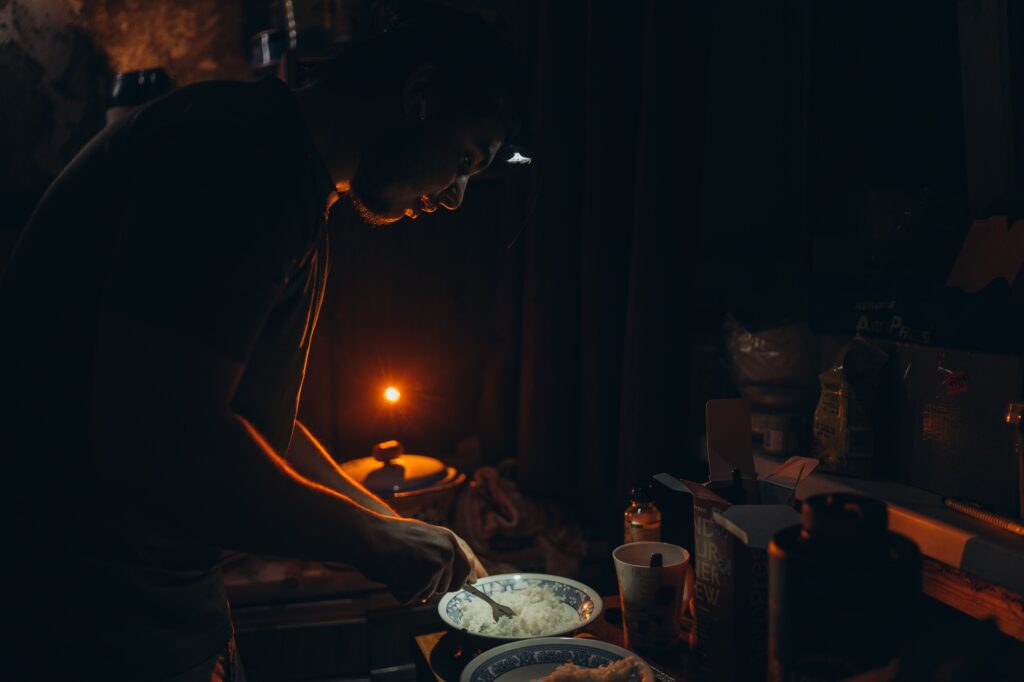
Frontline cuisine in Anastasiia Verbova’s photography

Message in a Bottle
Ukrainian wine Odyssey, full of passion